AI Voice Cloning & Biometric Theft: How 3 Seconds of Your Voice Became a Weapon (And How to Protect Your Family)
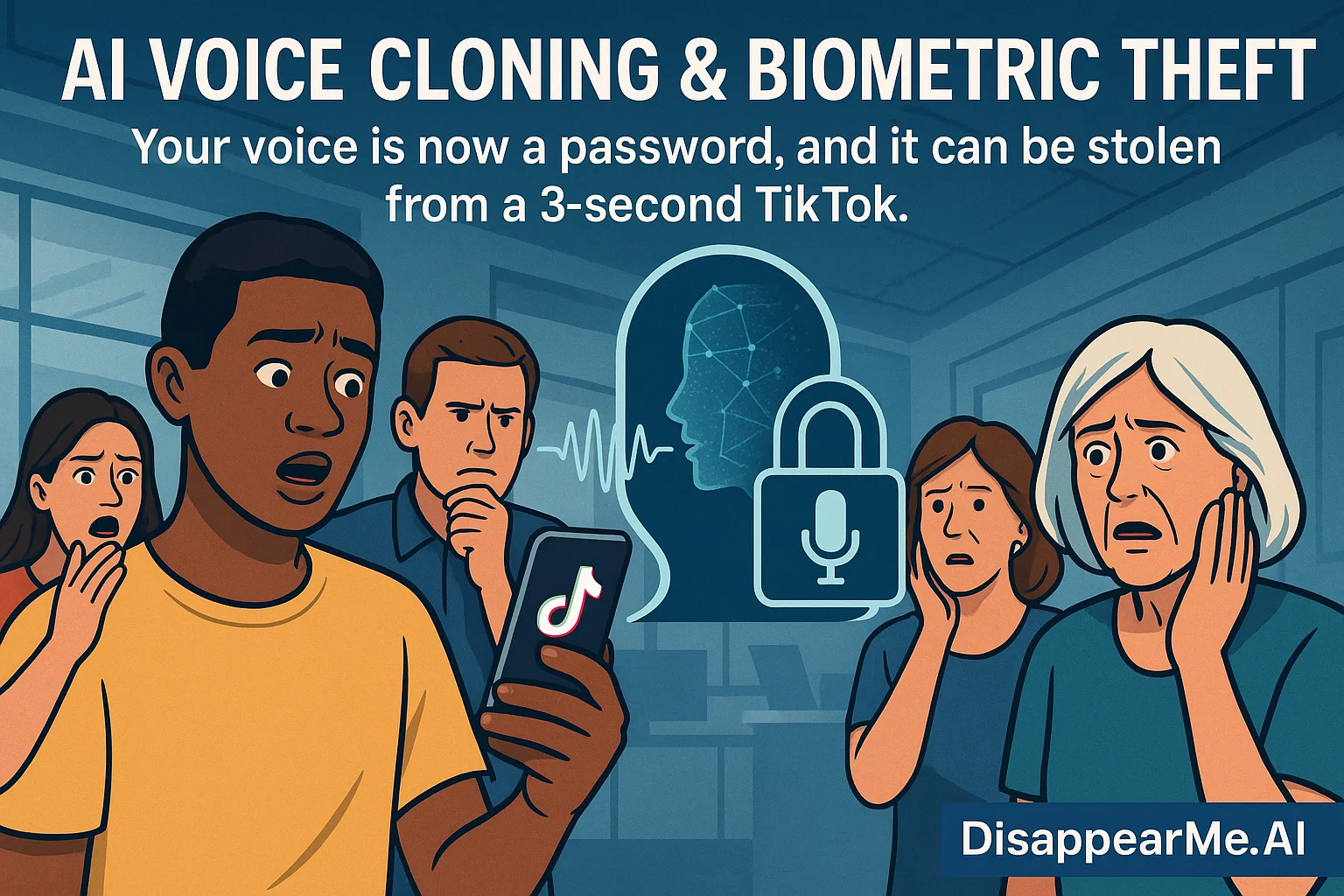
In December 2025, a mother received a call from a number she recognized. Her daughter's voice came through, panicked and terrified: "Mom, I've been kidnapped. The men have guns. They want $10,000 for bail or they're going to hurt me."
<!-- seo-engine:intro-bridge:start -->If you want companion reads while you work through this topic, start with AI Deepfake Identity Theft: How Synthetic Identities, Voice Cloning, and Deepfake Fraud Are Stealing Real Identities (2025-2026 Crisis) and Privacy for Parents: The 2026 Guide to 'Sharenting' and Facial Recognition (Or How to Disappear Your Child's Digital Footprint Before AI Weaponizes It). If you want a done-for-you plan, book a free exposure audit.
<!-- seo-engine:intro-bridge:end -->The voice was her daughter's. Every inflection, every word pattern, every vocal characteristic was unmistakably familiar. The panic in her voice was authentic-sounding. The urgency was real enough to bypass rational thought.
Her daughter was not kidnapped. The voice was an AI clone, created from a 3-second TikTok video the daughter had posted months earlier. Attackers had extracted that audio, processed it through an AI voice synthesis tool available for $9.99/month, and generated a realistic clone capable of saying whatever script they provided.
This is not science fiction. This is December 2025. And it's happening to families across the country.
The mother's story is one of thousands. In 2025, AI voice cloning attacks—called "vishing" (voice phishing)—surged 442% year-over-year. Corporate fraud losses through cloned CEO voices exceeded $40 billion globally. Families lost their life savings to kidnapping scams using their loved ones' cloned voices. Executives had their accounts drained by attackers cloning their CFO's voice.
Your voice is no longer a private possession. It's a dataset. Three seconds is all an attacker needs. A YouTube interview, a TikTok video, a LinkedIn presentation, a podcast appearance—any publicly available audio can be weaponized.
But voice cloning is only the crisis you know about. The deeper vulnerability is biometric theft: your face, fingerprints, and iris patterns have been stolen from government databases, corporate breaches, and airport systems. That data is being weaponized through AI-generated deepfakes and synthetic biometrics that can defeat authentication systems entirely.
This comprehensive guide explains the anatomy of AI voice and biometric attacks, introduces the "Safe Word Protocol" to protect your family from kidnapping scams, shows you how to remove your face from facial recognition and airport surveillance databases, and proves why relying on voice authentication for banking is now a critical security failure.
Emergency Doxxing Situation?
Don't wait. Contact DisappearMe.AI now for immediate response.
Call: (646) 484-9051
Email: oliver@disappearme.ai
Our team responds within hours to active doxxing threats.
The Crisis: How Your Voice Became a Weapon in 2025
The Technical Reality: What AI Voice Cloning Actually Requires
Understanding the threat requires understanding the technical simplicity that makes it so dangerous.
What Modern AI Voice Cloning Needs
Modern AI voice synthesis tools can clone a voice using just 3-30 seconds of audio. Here's what that means:
- 3 seconds: Minimum viable sample for basic voice cloning
- 10-30 seconds: Optimal sample for high-quality clones that capture subtle vocal characteristics
- Real-time generation: Advanced systems can generate speech in real-time, allowing natural two-way conversations
Three seconds. That's a single sentence. A TikTok video. An Instagram Reel. A YouTube short. Any public audio can become a training dataset for your voice's clone.
Where Attackers Get Your Voice
Once attackers decide you're worth targeting, they have unlimited sources:
- Social Media Videos - Every TikTok, Instagram Reel, YouTube video, LinkedIn video contains samples
- Conference Presentations - If you've ever spoken publicly, that's recorded and archived
- Podcast Appearances - Podcasts are permanently searchable audio archives
- Press Interviews - News interviews are published and searchable
- Earnings Calls - Corporate executives' quarterly earnings calls are publicly available
- Voicemail Messages - Hacked voicemail systems or phones can provide samples
- Phone Conversations - If they access your phone or intercept calls, they have samples
- Musical Performances - If you sing, that's a voice sample
- Video Advertisements - Company spokespeople in ads provide samples
- Training Videos - Educational content you've created
For CEOs, politicians, and public figures, the audio archive is enormous. For regular people, a few social media videos suffice.
The Processing Steps
Once an attacker has audio, the process is remarkably simple:
- Download and Isolate - Extract the audio from video or conversation (2-5 minutes)
- Clean Audio - Remove background noise and improve quality (5-10 minutes)
- Upload to AI Tool - Feed the audio to a voice cloning service (1 minute)
- Train Model - AI learns your voice characteristics (1-10 minutes, depending on service)
- Generate Speech - Type any text, and the AI produces your voice saying it (real-time)
- Deploy - Use the cloned voice for phone calls, videos, or deepfakes (immediate)
Total time from "I want to clone this person's voice" to "I can make phone calls impersonating them": approximately 1-2 hours.
Total cost: $10-$500 depending on the service and quality desired.
Technical skill required: Minimal. Tutorials on YouTube show step-by-step instructions.
The Real-Time Threat
The most dangerous aspect of 2025 voice cloning is that it can happen in real-time. Advanced systems support live voice generation, which means:
- Attackers don't need a pre-recorded script
- If the victim asks unexpected questions, attackers can respond immediately
- The conversation feels natural and adaptive
- There's no telltale delay that might trigger suspicion
- Victims never realize they're talking to a computer, not a person
This real-time capability transforms voice cloning from a single-message attack (scammers read a script) to a full impersonation attack (scammers hold natural two-way conversations).
The Statistics: The 2025 Voice and Biometric Crime Wave
The data is staggering:
Voice Cloning and Vishing Statistics (2025)
- 442% surge in voice phishing attacks year-over-year
- $40 billion in projected global fraud losses from vishing
- 3,000% increase in deepfake attacks since 2023
- 10%+ of major banks report losses exceeding $1 million each from deepfake calls
- 194% surge in deepfake scams in Asia-Pacific in 2024-2025
- Italian Defense Minister had his voice cloned and used to call business leaders in 2025
- German CEO authorized a $35 million transfer based on a cloned voice call (later recovered)
- UK Journalist successfully hacked his own Lloyds Bank account using an AI replica of his voice
- US Senators sent letters to the largest banks warning about "alarming application" of voice cloning in financial fraud
Biometric Theft and Breach Statistics (2025)
- 1,300% increase in biometric identity theft incidents in 2024
- 27.8 million records exposed in single Suprema Biostar 2 biometric database breach
- 5.6 million fingerprints of government employees exposed in 2015 OPM breach (still vulnerable today)
- 32% of UK business security breaches in 2024 involved deepfakes using stolen biometric data
- 1,400% growth in real-time deepfakes using tools like DeepFaceLive in 2024
- Multiple vulnerabilities in ZKTeco biometric terminals allowing SQL injection, command injection, and database manipulation
- GoldPickaxe.iOS Trojan steals facial recognition data from iOS devices at scale
The pattern is clear: AI voice cloning and biometric theft are now the dominant attack vectors, surpassing traditional phishing and credential stuffing.
The Anatomy of the Attack: From Voice Sample to Weaponization
Attack Pattern 1: The "AI Kidnapping Scam" (The Fear Factor)
The December 2025 voice cloning kidnapping scam demonstrates how attackers exploit emotional vulnerability:
Step 1: Intelligence Gathering
Attackers research their target. They identify:
- Who you call regularly (family, spouse, children)
- Your children's names, ages, schools
- Where you work and what you earn
- Whether you're wealthy enough to pay ransoms
- Social media presence (for voice samples)
This information comes from:
- Social media profiles (public information)
- Data brokers (buy comprehensive profiles)
- LinkedIn (professional information)
- Breached databases (personal details)
Step 2: Voice Sample Collection
Attackers identify public audio of a family member—typically a child or spouse:
- TikTok videos
- Instagram Reels
- YouTube channels
- Facebook videos
- LinkedIn profiles
- Podcast appearances
- School performances recorded and shared online
The minimum viable sample is 3 seconds. Most social media videos provide far more.
Step 3: Voice Cloning
Using an AI voice synthesis service ($10-$500):
- Upload the audio sample
- Train the AI model (1-10 minutes)
- Generate test outputs
- Refine for quality if needed
Step 4: Scripting
The attacker writes a kidnapping scenario script:
- Child reports being kidnapped
- Criminals demand ransom
- Threats about harm if police are called
- Specific demand for wire transfer to cryptocurrency exchange
The script is designed to trigger immediate emotional response and bypass rational thinking.
Step 5: Deployment
The attacker:
- Calls the parent using spoofed caller ID (shows as the child's phone number or unknown number)
- Deploys the voice clone either pre-recorded or in real-time
- Convinces the parent their child is kidnapped
- Demands wire transfer immediately
- Threatens harm if they call police or delay
Step 6: Money Collection
The parent, panicked and desperate:
- Wires money to cryptocurrency exchange or bank account
- Money is immediately transferred out of accessible locations
- By the time they realize it's a scam, the money is gone
The Psychological Exploitation
This attack works because:
- Emotional overload - Parents in panic don't think rationally
- Voice authenticity - The cloned voice is their loved one
- Authority imitation - Attackers pose as criminals (authority figures)
- Time pressure - Artificial urgency prevents verification
- Social proof - "Everyone in the family got a call, don't tell anyone or they'll kill them"
- Isolation - Parents are told not to call police, creating isolation and panic
Attack Pattern 2: "CEO Fraud via Voice Cloning" (The Financial Exploitation)
Corporate fraud through voice cloning represents the largest financial theft vector in 2025:
Real Case: The German CEO Scam (2025)
In 2025, a UK-based CEO of a large manufacturing company received a call. The caller ID showed his parent company's German CEO. The voice was unmistakably the German CEO's—same accent, same speech patterns, same business jargon.
The German "CEO" urgently requested an immediate wire transfer of several million euros for an acquisition that required secrecy. The caller explained that the deal was time-sensitive and that discussing it with other board members would jeopardize the entire transaction.
The UK CEO authorized the transfer. Within hours, the money was moved through cryptocurrency exchanges and disappeared.
Investigation later revealed:
- The German CEO had no knowledge of the call
- Attackers had cloned his voice from publicly available earnings call recordings
- The call was made in real-time, using AI voice synthesis that allowed the attacker to answer unexpected questions
- The fraud exploited corporate norms (do what the CEO says, move fast, keep quiet about deals)
Why Corporate Fraud Works
Voice cloning is devastatingly effective in corporate environments because:
- Authority Imitation - CEOs are authority figures; employees follow orders
- Urgency Culture - Business operates under time pressure; hesitation looks like incompetence
- Information Compartmentalization - Employees don't know about all decisions; secrecy seems normal
- Large Amounts - Wire authorization for millions is normal for large companies
- Verification Difficulty - Calling back the "CEO" confirms the number is registered to them (attacker spoofs caller ID)
In 2025, this attack pattern has moved beyond isolated incidents. It's systematic fraud targeting CFOs, treasurers, and finance leaders across industries.
Attack Pattern 3: "Biometric Deepfakes" (The Authentication Bypass)
The most sophisticated attack vector combines stolen biometric data with AI deepfake technology to defeat authentication systems:
How Biometric Data Is Stolen
Attackers obtain biometric data through:
- Database Breaches - Most common. Examples: Suprema Biostar (27.8M biometric records), government employee breaches (5.6M fingerprints), corporate security system breaches
- Physical Surveillance - High-quality photos, fingerprints lifted from surfaces, iris scans from distance
- Malware - Programs like GoldPickaxe.iOS steal facial recognition data from mobile devices at scale
- Government Databases - Law enforcement and immigration systems contain biometric databases accessible through insider threats or hacking
- Liveness Detection Bypass - Physical presentation attacks (masks, contact lenses, deepfake videos) defeat biometric sensors
- Supply Chain Attacks - Biometric devices shipped with pre-enrolled unauthorized templates or compromised firmware
How Biometric Deepfakes Defeat Authentication
Once an attacker has your biometric data:
-
Facial Recognition Deepfakes - Attackers create synthetic faces or deepfake videos that match your facial recognition templates with 40-70% success rates. Real-time deepfakes using DeepFaceLive enable live video manipulation during authentication (KYC verification for banking).
-
Fingerprint Reconstruction - Academic research has shown that sophisticated attacks can reconstruct usable fingerprint images from biometric templates, enabling physical or digital spoofing.
-
Iris Pattern Synthesis - Attackers can create artificial iris patterns from binary iris codes, defeating iris-based biometric systems.
-
Voice Biometric Cloning - AI-generated voice speech can bypass voice-based biometric systems that supposedly detect "spoofed" audio by analyzing artifacts. Modern deepfakes produce speech indistinguishable from genuine voice biometrics.
Why Biometric Authentication Is Now Obsolete
The fundamental problem with biometric authentication in 2025 is that biometric data is no longer secret. It's been breached, stolen, and exposed at massive scale. And unlike passwords, you cannot change your biometrics.
If an attacker obtains your biometric template, they possess a permanent key to your identity. The fingerprints stolen in the 2015 OPM breach remain vulnerable today—a decade later—because you cannot change your fingerprints.
The military's solution: removing biometric systems from high-security environments because they're now considered more of a liability than an asset.
The Safe Word Protocol: Protecting Your Family From AI Kidnapping Scams
What Is the Safe Word Protocol?
The Safe Word Protocol is a pre-agreed verification method that allows family members to confirm they're actually talking to each other, not to an AI clone or imposter. It's a simple, non-technical social engineering defense against the emotional manipulation of voice cloning scams.
The protocol works because:
- Attackers cannot guess your safe word - It's private family knowledge
- It's automated and immediate - No delays, no hesitation
- It works even if the voice is perfect - The safe word is the verification, not the voice
- It's impossible to spoof - The safe word proves identity independent of voice authenticity
- Children can understand and use it - No technical knowledge required
Implementing the Safe Word Protocol
Step 1: Create Your Family's Safe Word
Choose a word or phrase that:
- Is easy for family members to remember
- Is not publicly available (not a pet name you discuss on social media)
- Is not derivable from public information (not your street name, not your hometown)
- Cannot be guessed by someone researching your family (avoid birthdays, anniversaries, maiden names)
- Is unique to your family (make it up; don't use common phrases)
Examples of POOR safe words:
- "Fluffy" (pet names are public on social media)
- "Golden" (hometown colors or sports teams are findable)
- Your street name, city name, school name (all public information)
- "TrustMe" (too generic)
Examples of GOOD safe words:
- "Elephant Pancakes" (specific, memorable, not publicly derivable)
- "Purple Seventeen" (random combination only your family knows)
- "Backwards Flamingo" (nonsensical but memorable to family)
- "Specific family memory reference** - Something only family would know
The safest approach: Choose something completely random that you write down and share only in person, not through text, email, or any digital means that could be breached.
Step 2: Teach the Protocol to Your Family
This is critical—everyone must understand and practice the protocol:
For Young Children (Ages 5-10):
- Teach them: "If someone calls claiming to be Mom, Dad, Grandma, or Auntie, you ask them: 'What's our safe word?'"
- Practice with them: "I'm going to call you and pretend to be someone else. You ask me for the safe word. If I don't know it, hang up and call Mom/Dad."
- Make it a game: "We're playing the safe word game to protect ourselves from bad people who want to trick us with fake voices."
- Emphasize: "Even if the voice sounds like someone you love, if they don't know the safe word, it's probably not really them."
For Teens (Ages 11-17):
- Explain the voice cloning threat: "Criminals can now copy anyone's voice with just a 3-second audio clip. They can call and pretend to be family."
- Teach the protocol: "Always ask for the safe word if someone calls with unusual requests or emotional urgency."
- Emphasize that being asked for the safe word is normal: "Family members will expect this. It's not insulting; it's protective."
- Practice scenarios: "What if Grandma calls asking for money? What if Dad calls asking you to come pick him up?"
For Adults:
- Establish the protocol in family group chats: "We've implemented a safe word protocol. Here's our safe word: [Word]. If anyone contacts you claiming to be a family member, ask for this word before responding to urgent requests."
- Make it mandatory for requests involving:
- Money transfers or loans
- Urgent travel or bail
- Personal emergencies
- Unusual requests from someone who usually wouldn't ask
- Emphasize: "Even if the voice is absolutely convincing, ask for the safe word. Any legitimate family member will have it."
Step 3: Implement the Rule
Make it a firm family rule:
The Rule: "If any family member, friend, or contact makes an urgent or unusual request (especially involving money, travel, emergency situations, or bail), you must ask for the safe word before responding."
Exceptions: None. Even if you're 99% sure it's them, ask for the safe word. It takes 3 seconds and eliminates the entire class of voice cloning scams.
Step 4: Practice Regularly
Safety protocols only work if people practice them:
- Monthly check-ins - Random family calls where one person practices asking for the safe word
- Scenario exercises - "Your friend calls claiming their car broke down and they need money. What's the first thing you do?"
- Teach extended family - Grandparents, aunts, uncles, cousins all need to understand the protocol
- Update younger children - As they grow and social media use increases, remind them of the protocol
Biometric Opt-Out: Removing Your Face From Surveillance and Authentication Databases
The Biometric Ecosystem: Where Your Face Is Stored
Your facial data exists in far more places than you realize. Understanding these sources is the first step to opting out.
Government Biometric Databases
Driver's License Databases
- Every state maintains facial recognition databases of driver's license photos
- These databases are accessible to law enforcement
- Some states share data with federal agencies
- Your photo persists even if your license expires or is renewed
How to Opt Out (Limited Options):
- Contact your state's DMV/Department of Motor Vehicles
- Request that your photo not be used for facial recognition matching (most states allow this)
- Understand that your photo will still exist in the database; you're just opting out of being matched
- Different states have different policies; some allow more control than others
- This is an ongoing battle; states are expanding facial recognition access, making opt-out difficult
Passport and Travel Documents
- The State Department maintains facial databases of all passport holders
- These databases are used for international travel verification
- Information can be shared with law enforcement and intelligence agencies
How to Opt Out:
- Very limited options for passports
- You can request privacy protections under FOIA (Freedom of Information Act)
- Contact the State Department's Privacy Officer to request information about how your passport photo is used
Law Enforcement Databases
- If you've ever been arrested, your mugshot is in law enforcement databases
- These databases are increasingly accessible through facial recognition systems
- Mugshots persist indefinitely, even if charges are dropped or expunged
How to Opt Out:
- Mugshots can sometimes be removed if charges are dropped or expunged
- Contact the arresting agency's public records department
- In some states, you can request expungement, which removes records
- This process varies significantly by state and is often challenging
Immigration and Border Databases
- CBP (Customs and Border Protection) maintains facial recognition databases of all border crossers
- TSA maintains facial recognition data at airports
- These are shared with international partners
- Your biometric data is retained indefinitely
How to Opt Out:
- Very limited options for border and airport databases
- You can request information about what's stored using Privacy Act requests
- International travel requires biometric data; opting out means not traveling internationally
Commercial Biometric Databases
Clearview AI
- Private company that scraped billions of photos from social media and public websites
- Created comprehensive facial recognition database available to law enforcement
- Contains billions of faces without consent
How to Remove Your Face:
- Go to Clearview AI's website: www.clearview.ai
- Submit a removal request with your contact information and photos showing your face
- Provide proof of identity
- Clearview will remove you from their database for non-law enforcement use (law enforcement can still access)
- Request written confirmation of removal
- Regularly check for re-population
Important Note: Clearview AI will remove you from commercial/private use, but law enforcement can still access your data. Some states have passed laws requiring more restrictive Clearview access, but comprehensive removal is impossible.
ID.me (Identity Verification Platform)
- Used by government agencies (IRS, Social Security, veteran benefits) for identity verification
- Maintains facial recognition data
- Increasingly used in private sector for age verification
How to Remove Your Face:
- Go to ID.me: www.id.me
- Log into your account (create one if necessary)
- Go to "Settings" → "Privacy"
- Request removal of your biometric data
- ID.me will provide options to delete your account and associated biometric data
- Confirm deletion
Important: When you verify identity with ID.me for government services, your facial data may be retained. To avoid this, use non-biometric verification methods if available.
Facebook/Meta Facial Recognition Data
- Meta maintains facial recognition templates of billions of users
- Used for automatic photo tagging and facial recognition features
- Data is not always deleted even if you delete your account
How to Remove Your Face:
- Go to Facebook Settings → Apps and Websites
- Find facial recognition privacy controls
- Disable "Face Recognition" feature
- Go to Settings → Privacy → "Do you want to allow face recognition?"
- Select "No"
- Go to Facebook's facial recognition tool: www.facebook.com/recognize
- If your face has been identified in photos, you can remove yourself
Important: Disabling face recognition prevents META from identifying you in future photos, but historical facial recognition data may persist.
Google/YouTube Facial Recognition
- Google Photos uses facial recognition for automatic photo organization
- YouTube uses facial recognition for recommendation algorithms
- Google Search results include facial recognition data
How to Remove Your Face:
- Go to Google Account: myaccount.google.com
- Click "Data & privacy" → "Web & App Activity"
- Go to "Search settings" and disable facial recognition features
- In Google Photos: disable facial recognition in settings
- Submit removal request for your face in Google Image Search
- Contact Google's Privacy Team for comprehensive removal request
Airport and Travel Biometric Systems
TSA Facial Recognition
- TSA is expanding facial recognition at airport security checkpoints
- Technology scans passengers and compares faces to government databases
- Data is retained in TSA systems
How to Opt Out:
- Inform TSA officer at security checkpoint that you want to opt out of facial recognition
- You have the legal right to opt out
- You will be required to provide alternative identification verification
- This will slow down your security process, but it's your right
CBP Facial Recognition (Border Crossings)
- CBP (Customs and Border Protection) uses facial recognition at all land and air borders
- All international travelers are photographed
- No realistic opt-out; facial recognition is mandatory for international travel
What You Can Do:
- Request information about what data CBP maintains using Privacy Act requests
- File complaints if you believe your data is being misused
- Advocate for stricter regulations on CBP biometric data use
Private Sector Biometric Databases
Retail and Payment Systems
- Some retailers use facial recognition for customer identification and payment verification
- Payment systems may use facial recognition for fraud detection
How to Opt Out:
- Ask retailers and payment providers if they use facial recognition
- Request that your face not be used for identification
- Most retailers don't have formal opt-out systems; you must request directly
Financial Institutions
- Banks increasingly use facial recognition for account verification
- Some request facial photos for identity verification during account opening
How to Opt Out:
- When opening accounts, request non-facial-recognition alternatives
- Request that your photo not be used for facial recognition
- Regularly verify that facial recognition is not enabled on your account
- Request deletion of stored facial data
Complete Biometric Removal Protocol
Phase 1: Immediate Freeze and Opt-Out
-
Contact all relevant agencies - Write to government agencies (DMV, Social Security, IRS, State Department) requesting:
- Explanation of what biometric data they maintain about you
- Options for opting out of facial recognition matching
- Confirmation that your data won't be sold or shared for commercial purposes
-
Contact commercial services - Submit removal requests to:
- Clearview AI (removal from commercial use)
- ID.me (request account deletion)
- Facebook/Meta (disable facial recognition)
- Google (removal from Google Images, disable in Google Photos)
-
Document everything - Keep records of:
- Dates of opt-out requests
- Confirmation numbers if provided
- Company responses
- Timelines for removal
Phase 2: Limit Future Biometric Collection
-
Social Media Privacy Settings - Restrict who can post photos of you:
- Facebook: Disable photo tagging permissions
- Instagram: Disable tagging in settings
- TikTok: Approve posts with your face
- LinkedIn: Remove profile photo or use generic image
-
Limit Photo Sharing - Be intentional about where your face appears:
- Don't post facial close-ups on social media
- Wear sunglasses or masks in public if concerned about surveillance cameras
- Request that events/conferences not publish your photos
-
Avoid Biometric Authentication - When possible, use alternatives:
- Use PINs instead of fingerprint authentication
- Use passwords instead of face recognition
- Use hardware security keys instead of biometric authentication
Phase 3: Continuous Monitoring
-
Quarterly Biometric Searches - Search for your face:
- Google Images: Search your name
- Reverse image search: Upload your photo to find where it appears
- Clearview AI: Check if you've been re-added to their database
- Social media: Verify privacy settings are still enabled
-
Monitor Breaches - Check for biometric data breaches:
- HaveIBeenPwned.com: Monitor for biometric breaches
- News alerts: Set up alerts for your name + "facial recognition" or "biometric breach"
- Government breach notifications: Sign up for notification services
-
Re-Submit Removal Requests - If your data reappears:
- Re-submit requests to Clearview AI, ID.me, Google
- Contact government agencies again
- Document re-population attempts for potential legal action
Turn Chaos Into Certainty in 14 Days
Get a custom doxxing-defense rollout with daily wins you can see.
- ✓✅ Day 1: Emergency exposure takedown and broker freeze
- ✓✅ Day 7: Social footprint locked down with clear SOPs
- ✓✅ Day 14: Ongoing monitoring + playbook for your team
Why Voice Authentication for Banking Is Now Critically Obsolete
The Fundamental Problem: Voice Is No Longer Secret
Banks have spent billions implementing voice biometric authentication—where customers are identified by their voice rather than password or PIN. The reasoning seemed sound: voice is unique, difficult to forge, and provides convenience (just call and say who you are).
In 2025, this logic has been catastrophically undermined by AI voice cloning.
The UK Journalist Hack
In April 2025, security journalist Joseph Cox attempted to hack his own Lloyds Bank account using only AI-generated voice cloning. He:
- Collected 3-10 minutes of audio samples from publicly available content
- Used AI voice synthesis tools ($20-$100) to create a realistic clone of his own voice
- Called Lloyds Bank's voice authentication system
- Successfully convinced the system he was Joseph Cox
- Gained access to his account, saw balances, recent transactions, and could potentially authorize transfers
Lloyds Bank's voice authentication—purportedly sophisticated security—was bypassed entirely by AI voice cloning. And this was just one journalist testing on his own account. Real attackers, targeting victims outside the bank, have achieved the same bypass with even greater success.
The Technical Reality
Banks' voice authentication systems are designed to detect "spoofed" audio—recordings that sound unnatural or have artifacts indicating synthetic generation. This worked when deepfakes were obviously fake.
Modern AI voice cloning produces speech that is:
- Indistinguishable from genuine voice
- Free of obvious artifacts
- Adaptable to real-time conversation
- Resistant to current detection methods
Banks' authentication systems cannot reliably distinguish between genuine voice and AI-cloned voice because the AI is now that sophisticated.
The Policy Problem
Even if banks could detect deepfake voices (which they largely cannot), the fundamental problem remains: voice authentication assumes your voice is secret and cannot be replicated. That assumption is now false.
Every executive, every public figure, anyone who's done a podcast, interview, or public presentation has exposed their voice to potential cloning. Even private individuals who've never spoken publicly can be targeted—attackers can record phone calls or voicemails if they have access to your phone.
Why Banks Continue Using Voice Authentication Anyway
Banks have sunk substantial capital and regulatory approval into voice authentication systems. Acknowledging that the systems are now obsolete is costly. So they continue deploying voice authentication despite knowing the vulnerability, hoping the problem doesn't become mainstream knowledge.
Some banks are beginning to transition away from voice-only authentication, implementing multi-factor verification (voice + PIN + security questions), but this is limited. The transition is slow because it requires admitting the prior system failed.
What You Should Do: Avoiding Voice Authentication for Banking
If Your Bank Offers Voice Authentication
- Do not enroll - Decline voice authentication if your bank offers it
- Use alternatives - Use PIN-based authentication, hardware security keys, or biometric authentication tied to your device (not voice)
- Contact your bank - Write to your bank's security team:
- "I am declining voice authentication because AI voice cloning poses unacceptable risk"
- Request alternative authentication methods
- Request written confirmation that you've opted out of voice authentication
If Your Bank Requires Voice Authentication
Some banks are making voice authentication mandatory (increasingly common):
- Switch banks - Change to a bank that doesn't require voice authentication
- Request exemption - Contact the bank's security team requesting exemption based on voice cloning risks
- Use alternative verification - When possible, use their mobile app or hardware key for authentication instead of calling
For Cryptocurrency and High-Value Accounts
Avoid any platform that uses voice authentication entirely:
- Do not use voice for cryptocurrency exchange account recovery
- Do not use voice for high-value bank accounts
- Use hardware security keys (physical devices that cannot be cloned)
- Use authenticator apps instead of SMS or voice verification
The Future of Authentication
The only authentication methods resistant to AI deepfakes are:
- Hardware Security Keys - Physical devices that prove you have something (cannot be cloned remotely)
- Cryptocurrency-Based Identity - Using blockchain-based verification that cannot be spoofed
- Multi-Factor Combining Non-Biometric Methods - Password + hardware key + location verification (not voice or face recognition)
Biometric authentication (face, voice, fingerprint) is increasingly obsolete because the underlying biometric data is no longer secret. Authentication methods must move to proving you possess something (hardware key, private key) rather than proving you are something (voice, face, fingerprint).
Frequently Asked Questions About Voice Cloning and Biometric Protection
Q: Can I prevent my voice from being cloned?
No, not completely. If your voice is publicly available in any form (social media, podcasts, interviews), it can potentially be cloned. However, you can:
- Limit public audio availability (reduce social media videos, interviews)
- Never record voice messages for voicemail or automated systems with sensitive content
- Teach family to use the Safe Word Protocol to verify your identity
- Opt out of voice authentication systems
- Monitor for clones of your voice being used
The practical protection is not preventing cloning (largely impossible) but rather educating family and contacts to verify identity through alternative means.
Q: If someone clones my voice and impersonates me, is that illegal?
Yes. Voice cloning for fraud, impersonation, and financial crimes is illegal under:
- Wire fraud statutes (federal)
- Deepfake-specific legislation (emerging in states like California, Texas, Virginia)
- Identity theft laws
- Telephone fraud statutes
However, enforcement is difficult because:
- Detection is challenging (the voice sounds real)
- Perpetrators often operate internationally
- Digital evidence is complex
- Law enforcement is still developing expertise
If you believe you've been victimized, report to:
- FBI Cybercrimes Division
- Local law enforcement
- IC3 (Internet Crime Complaint Center)
- Your attorney for potential civil action
Q: Should I stop using social media to prevent voice cloning?
Reducing your social media presence reduces your voice exposure, but complete prevention is unrealistic. Instead:
- Limit video content (restrict voice samples)
- Use privacy settings to limit who can access your content
- Download and delete old videos that expose your voice
- Never post voice messages, voicemails, or intimate recordings
The balance: You can use social media but be intentional about audio exposure.
Q: What about the facial recognition data that's already been exposed?
Facial recognition data that's been breached cannot be un-breached. However, you can:
- Opt out of future facial recognition collection
- Request removal from databases where legally possible
- Avoid enrolling in new biometric systems
- Change appearance (hair, glasses, makeup) to reduce facial recognition matches (temporary protection)
- Monitor for misuse of your facial data
Q: Can DisappearMe.AI protect my voice and biometric data?
DisappearMe.AI is developing voice and biometric privacy services including:
- Monitoring for your voice being cloned or used maliciously
- Assisting with biometric opt-outs from commercial databases (Clearview, ID.me, etc.)
- Safe Word Protocol education and family coordination
- Documentation of voice cloning incidents for legal purposes
- Facial recognition database removal assistance
Current services focus on database removal and monitoring; preventing initial cloning is not yet possible but is being researched.
Q: Why haven't banks stopped using voice authentication?
Banks have sunk significant capital into voice authentication systems and received regulatory approval for them. Admitting the systems are obsolete is costly. Additionally:
- The transition to alternative authentication requires investment
- Regulatory approval for new systems takes time
- Some banks are slow to recognize the threat
- Voice-only breaches haven't yet been publicly catastrophic (though many have occurred)
Pressure from customers and regulators is beginning to force change, but it's slow.
Q: Is facial recognition at airports required?
TSA facial recognition at airport security is currently optional. You have the right to:
- Inform the TSA officer you want to opt out
- Refuse facial scanning
- Go through alternative security verification
However, this will slow your security screening. You have a legal right to opt out, but the process is not designed to be convenient.
About DisappearMe.AI
DisappearMe.AI recognizes that 2025 represents a fundamental shift in how identity is attacked. Traditional privacy protection focused on securing passwords, preventing data breaches, and limiting location tracking. These protections remain important, but they're now insufficient.
The emerging threat vector is biometric and voice-based identity theft, enabled by AI technology that can clone voices from 3-second audio clips and generate deepfake videos indistinguishable from reality. This attack surface cannot be prevented through traditional privacy methods.
DisappearMe.AI's approach to voice and biometric privacy is multi-layered:
Immediate Family Protection: The Safe Word Protocol protects families from AI kidnapping scams and voice cloning impersonation. It's simple, non-technical, and effective.
Biometric Database Removal: Systematic removal of your facial data from commercial databases (Clearview AI, ID.me, etc.), government systems (where possible), and social media platforms.
Voice Cloning Monitoring: Detecting if your voice is being cloned or used maliciously online.
Authentication Transition: Guiding users away from obsolete biometric authentication toward hardware-key-based systems.
Documentation and Legal Support: Maintaining records of all removal efforts and voice cloning incidents for potential legal action against perpetrators.
Your voice and your face are no longer uniquely yours. They've been weaponized by AI technology and stolen from databases at massive scale. DisappearMe.AI helps you protect your voice, your biometric data, and most importantly, your family from AI voice cloning and biometric identity theft.
The Safe Word Protocol is your first defense. DisappearMe.AI is your comprehensive protection.
Threat Simulation & Fix
We attack your public footprint like a doxxer—then close every gap.
- ✓✅ Red-team style OSINT on you and your family
- ✓✅ Immediate removals for every live finding
- ✓✅ Hardened privacy SOPs for staff and vendors
References
-
Malwarebytes. (2025). "Deepfakes, AI Resumes, and the Growing Threat of Fake Applicants." Retrieved from https://www.malwarebytes.com/blog/inside-malwarebytes/2025/12/deepfakes-ai-resumes-and-the-growing-threat-of-fake-applicants
-
ThreatLocker. (2025). "AI Voice Cloning and Vishing Attacks: What Every Business Must Know." Retrieved from https://www.threatlocker.com/blog/ai-voice-cloning-and-vishing-attacks-what-every-business-must-know
-
MxD USA. (2025). "Warning: The AI Deepfake Danger Intensifies." Retrieved from https://www.mxdusa.org/2025/11/14/warning-the-ai-deepfake-danger-intensifies/
-
Axios. (2025). "AI Voice Scam in Lawrence Sparked Armed Police Response." Retrieved from https://www.axios.com/local/kansas-city/2025/12/04/ai-voice-scam-lawrence-police
-
BRside. (2025). "Deepfake CEO Fraud: $50M Voice Cloning Threat to CFOs." Retrieved from https://www.brside.com/blog/deepfake-ceo-fraud-50m-voice-cloning-threat-cfos
-
Interface Media. (2025). "AI, Facial Recognition, and the Rising Threat of Biometric Theft." Retrieved from https://interface.media/blog/2025/02/26/ai-facial-recognition-and-the-rising-threat-of-biometric-theft/
-
iProov. (2024). "Voice Biometrics in Banking: A False Sense Of Security?" Retrieved from https://www.iproov.com/blog/voice-biometrics-false-security
-
DeepStrike. (2025). "Vishing Statistics 2025: AI Deepfakes Drive $40B in Losses." Retrieved from https://deepstrike.io/blog/vishing-statistics-2025
-
andopen. (2025). "What is Biometric Identity Theft and What Protections Exist?" Retrieved from https://andopen.co.kr/what-is-biometric-identity-theft-and-what-protections-exist/
-
Gnani.ai. (2025). "Voice Authentication for Banks: A Safer Way to Enhance Security." Retrieved from https://www.gnani.ai/resources/blogs/voice-authentication-for-banks-a-safer-way-to-enhance-security/
Related Reading
- AI Deepfake Identity Theft: How Synthetic Identities, Voice Cloning, and Deepfake Fraud Are Stealing Real Identities (2025-2026 Crisis)
- Privacy for Parents: The 2026 Guide to 'Sharenting' and Facial Recognition (Or How to Disappear Your Child's Digital Footprint Before AI Weaponizes It)
- Children's Digital Footprint & Sharenting: Your Kid's Childhood Is a Permanent Data Record (And How to Protect It)
Take the Next Step
If you want DisappearMe.ai to handle the database deletion wave and ongoing leakage monitoring for you, start with a Features and review Free exposure audit.
<!-- seo-engine:next-step:end --> <!-- seo-engine:references:start -->References and Further Reading
<!-- seo-engine:references:end -->Related Articles
AI Deepfake Identity Theft: How Synthetic Identities, Voice Cloning, and Deepfake Fraud Are Stealing Real Identities (2025-2026 Crisis)
AI deepfake identity theft crisis: synthetic identity fraud (46% of fraud experts), voice cloning attacks, deepfake-as-a-service, biometric spoofing, and how to protect yourself from AI-powered identity theft.
Read more →Children's Digital Footprint & Sharenting: Your Kid's Childhood Is a Permanent Data Record (And How to Protect It)
Sharenting creates permanent digital records of your child before they can consent. Learn how to delete your child's digital footprint, protect photos from AI, and escape school app surveillance with DisappearMe.AI's family privacy guide.
Read more →Privacy for Parents: The 2026 Guide to 'Sharenting' and Facial Recognition (Or How to Disappear Your Child's Digital Footprint Before AI Weaponizes It)
1,300 photos by age 13. Facial recognition databases. AI deepfakes targeting children. Learn how to remove child photos from internet, disappear from facial recognition, and protect your kids from sharenting dangers with DisappearMe.AI before they turn 18.
Read more →