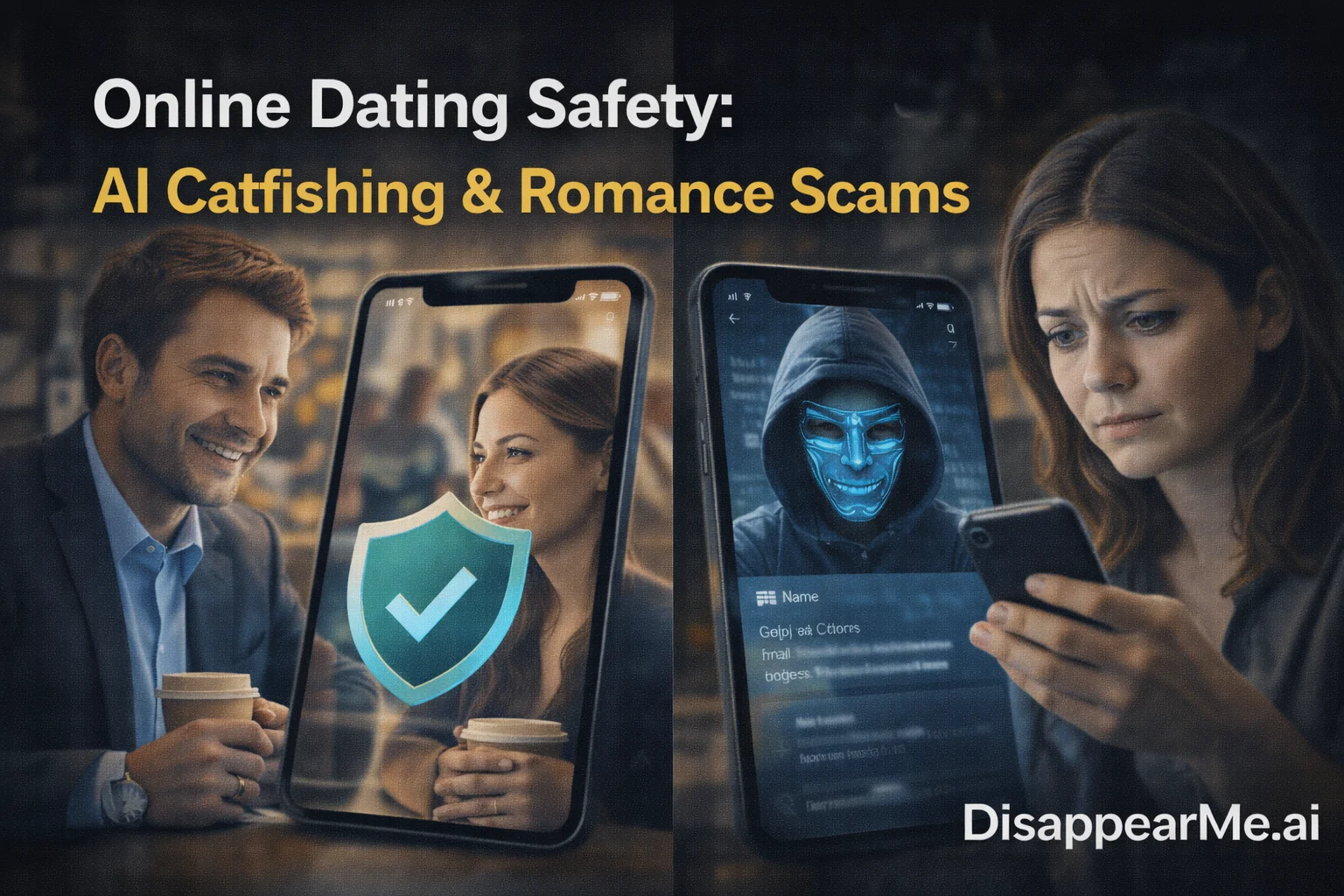
Online Dating Safety Crisis: How AI Catfishing, Romance Scams, and Fake Profiles Enable Fraud, Sextortion, and Why Your Information on Data Brokers Makes You a Target (2025)
Emergency Doxxing Situation?
Don't wait. Contact DisappearMe.AI now for immediate response.
Call: (646) 484-9051
Email: oliver@disappearme.ai
Our team responds within hours to active doxxing threats.
PART 1: THE CRISIS SCALE - Romance Fraud in 2025
The Financial Impact
The Devastating Statistics:
<!-- seo-engine:intro-bridge:start -->If you want companion reads while you work through this topic, start with Small Business Owner & Freelancer Privacy Crisis: Why Your Personal Information Is Weaponized Against Your Business, How Data Brokers Enable Targeting, and Why Business Protection Requires Personal Privacy (2025) and Executive Privacy Crisis: Why C-Suite Leaders and Board Members Are Targeted, How Data Brokers Enable Corporate Threats, and Why Personal Information Protection Is Now Board-Level Risk Management (2025). If you want a done-for-you plan, book a free exposure audit.
<!-- seo-engine:intro-bridge:end -->According to Low Cost Detectives analysis of 2025 romance fraud data:
- $1.3 billion lost in 2024 (most recent complete data)
- Up from $547 million in 2021 (137% increase in 4 years)
- Average loss per victim: $15,000 (often represents life savings)
- 1 in 4 online daters targeted by scams in 2025
- 64% increase in scam blocking (fraud accelerating)
- Victims aged 50+: Nearly half of all victims
- U.S. hosts 38% of detected new scam profiles globally
The Reality:
Romance scams are now a $1.3 billion annually industry.
Not a scam. An industry.
Organized, sophisticated, profit-driven operations.
Why Romance Scams Are Escalating
The Market Conditions:
-
Massive Dating App Adoption:
- Over 300 million active users globally
- Millions of new profiles daily
- High transaction volume = more targets
-
Emotional Vulnerability:
- People seeking relationships are emotionally vulnerable
- Scammers exploit loneliness and desire for connection
- Victims more willing to overlook red flags (emotional override)
- Sunk cost fallacy (already invested emotionally, easy to ask for money)
-
High Profitability:
- $15,000 average loss per victim
- Low risk (difficult prosecution across jurisdictions)
- Low cost to operate (AI automates profiles)
- Recurring revenue (victim keeps sending money)
-
AI Acceleration:
- AI makes profile creation cheaper and easier
- AI-generated faces are nearly indistinguishable from real
- AI can sustain conversations for weeks
- AI reduces operational cost per scammer
Result: Economic incentives favor romance scammers.
PART 2: THE AI CATFISHING EXPLOSION - How Technology Changed the Threat
Traditional Catfishing (Pre-2024)
The Old Method:
- Scammer steals photos of real person (or uses AI)
- Creates fake profile with stolen identity
- Builds romantic relationship via messaging
- Makes excuses to avoid video calls
- Asks for money (emergency, travel, medical)
- Victim sends money or refuses
- Scammer disappears
The Red Flags:
- Profile photos too perfect (obvious stolen images)
- Refuses video calls (excuse always "technical issue")
- Avoids direct questions (inconsistent backstory)
- Typos or grammatical errors (low English proficiency)
- Rushes emotional progression (too fast)
- Quick requests for money (true motivation)
The Detection:
- Reverse image search revealed stolen photos
- Slight inconsistencies exposed lies
- Video call request exposed fake identity
The Success Rate:
- ~10-15% conversion (most victims caught on)
- Limited operational scale (manual work)
- High failure rate (easy to spot inconsistencies)
AI-Generated Catfishing (2025 Reality)
The New Method:
- Scammer uses AI to generate photos (no stolen images)
- AI generates consistent backstory and details
- AI maintains conversation across weeks
- AI learns victim's preferences and language patterns
- AI generates personalized messages matching victim's communication style
- Asks for money at optimal emotional moment
- If victim hesitates, AI escalates emotional manipulation
- If victim still hesitates, coordinated team takes over
The AI Advantages:
According to Norton and Look At My Profile 2025 research:
- No stolen photos to detect: AI-generated faces are unique and pass image reverse searches
- No inconsistencies: AI doesn't make typos or grammatical errors (or intentionally matches victim's style)
- No avoidance of calls: Can use deepfake video (synthesized video appearing real)
- Personalized escalation: AI can craft hundreds of unique personas to A/B test which works best
- Sustained conversation: AI can maintain relationships for weeks, building deep emotional connection
- Scale: Can run thousands of simultaneous conversations (vs manual approach of dozens)
The Red Flags (Now Obsolete):
Traditional warning signs no longer work:
- Perfect photos? Generated consistently by AI (not stolen)
- Perfect grammar? AI produces flawless text
- Consistent story? AI never forgets details
- Avoids video? Deepfake makes convincing synthetic call
- Quick emotional rush? Intentional by design (not inconsistent)
The New Reality:
According to Norton Cyber Safety Insight Report (2025):
- Less than half of online daters can distinguish real dating profile photos from AI-generated ones
- Romance scams now at 37% of dating fraud (catfishing at 23%)
- Catfishing using AI makes it nearly impossible to detect via traditional methods
PART 3: HOW INFORMATION EXPOSURE ENABLES DATING FRAUD
The Information Supply Chain for Dating Predators
Step 1: Victim Identification Through Data Brokers
Predators use data brokers to identify high-value targets:
Target Profile:
- Aged 50+ (statistically most vulnerable and financially stable)
- Single or divorced (lonely, seeking connection)
- High net worth (has money to send)
- Professional (reputation vulnerability, won't report)
- Limited tech savvy (easier to manipulate)
Information Available:
- Full name
- Address (current and historical)
- Phone number
- Email addresses
- Age
- Property ownership
- Net worth estimates
- Employment information
- Family relationships
The Cost: $10-50 per profile
The ROI: If 1 in 100 targets converts at $15,000 average loss = $150,000 return per $500 investment
The Calculation Makes Sense to Predators
Step 2: Social Media Intelligence Gathering
Once identified, predator researches target:
On Social Media (Facebook, LinkedIn, Instagram, etc):
- Photos of victim (used to understand appearance, lifestyle)
- Posts about interests and hobbies
- Relationship status and history
- Travel patterns
- Daily routines and locations
- Family information
- Educational background
- Job history and current employment
- Political/religious beliefs (indicates values and vulnerabilities)
- Recent life events (breakup, retirement, loss, indicating emotional vulnerability)
The Intelligence Advantage:
Predator now knows:
- How to make AI-generated persona appealing to this specific victim
- What conversations will resonate
- What emotional vulnerabilities to exploit
- When victim is most lonely (based on posting patterns)
- What false story will be most believable
- How to build deepest emotional connection with highest ROI
Step 3: Personalized AI Catfishing
Armed with complete information about target:
Custom Persona Creation:
AI generates:
- Photos designed to appeal to victim's stated preferences
- Backstory matching victim's interests and values
- Personality matching victim's communication style
- Fictional history of similar life events (creating relatable connection)
- Work/education that appeals to victim (parallel status)
Personalized Messaging:
- References to victim's hobbies in initial conversation
- Demonstrates knowledge of victim's interests
- Uses victim's communication style (formal/casual, emoji use, humor)
- Escalates emotional connection based on victim's attachment patterns
- Identifies emotional vulnerabilities and exploits them
The Effectiveness:
Victim believes:
- "This person knows me"
- "They understand me"
- "We have real connection"
- "This is genuine relationship"
All programmed by AI using stolen personal information.
Step 4: Coordinated Extraction
Once emotional connection established:
Financial Request Phase:
- Initial small request (building compliance)
- Victim sends money easily (emotional override)
- Larger request follows
- AI escalates emotional manipulation
- "I need $15,000 for travel emergency"
- "I need $30,000 for investment opportunity"
- If victim hesitates, human team takes over
- Real person (different voice, new identity) takes over conversation
- Escalates urgency and emotional pressure
- Victim sends large sum ($15,000 average)
Result: Predator profits from emotional manipulation enabled by information exposure.
PART 4: THE SEXTORTION CONNECTION - Information Exposure Enables Sexual Exploitation
How Dating Predators Escalate to Sextortion
The Progression:
- Emotional Connection Established: Victim believes genuine relationship
- Trust Built: Victim willing to share intimate details
- Photo Request: "Send me a photo so I can see you"
- Intimate Photo Obtained: Victim trusts predator, sends intimate image
- Threat Transition: "I have your photo. I know your family. Send money or I post it everywhere"
- Sextortion Initiated: Financial demands backed by threat of public humiliation
The Information Advantage:
Predator has:
- Victim's real name and address (from data brokers)
- Family members' information (from social media, data brokers)
- Employer information (from LinkedIn, data brokers)
- Home address where family is located
- Ability to credibly threaten: "I know where your daughter goes to school"
The Leverage:
Victim faces:
- Public humiliation (intimate photos posted)
- Family humiliation (photos sent to family members)
- Job loss (photos sent to employer)
- Relationship destruction (photos sent to spouse)
- Location threat (predator "knows where you live")
All enabled by information available on data brokers.
The Scale of Sextortion
The Statistics:
According to Avast analysis:
- Sextortion increased 137% in 2025
- Often begins on dating apps
- Victims of romantic fraud particularly vulnerable
- Once intimate image obtained, sextortion follows
The Victim Experience:
Victim is:
- Already emotionally manipulated (by catfishing)
- Already sent money (compliance established)
- Holding intimate images (collected under false pretenses)
- Now facing sexual exploitation threat
- Terrorized by threat against family members
Multiple layers of victimization.
Turn Chaos Into Certainty in 14 Days
Get a custom doxxing-defense rollout with daily wins you can see.
- ✓✅ Day 1: Emergency exposure takedown and broker freeze
- ✓✅ Day 7: Social footprint locked down with clear SOPs
- ✓✅ Day 14: Ongoing monitoring + playbook for your team
PART 5: THE DETECTION PROBLEM - Why Modern Scams Are Hard to Spot
The AI Advantage Over Traditional Detection
What Used to Work:
- Reverse image search (revealed stolen photos)
- Video call request (exposed fake identity)
- Inconsistency checking (caught lies)
- Grammar/spelling analysis (detected non-native fraud)
- Behavioral pattern analysis (caught social engineering)
Why It Doesn't Work Anymore:
-
AI-Generated Images:
- Unique to each conversation (no stolen images to find)
- Pass reverse image search (not stolen, no matches)
- Consistent improvement (deepfakes now convincing)
-
Deepfake Video Calls:
- Synthetic video appears real
- Facial expressions respond to conversation
- Real-time deepfakes now possible
- Victim can't distinguish from real
-
No Inconsistencies:
- AI never forgets details
- Maintains consistent backstory for weeks
- Matches victim's communication style perfectly
- No grammatical errors (unless intentional)
-
Behavioral Adaptation:
- AI learns victim's patterns
- Adapts communication to maximize emotional impact
- Escalates at optimal moments
- Tests multiple approaches simultaneously
The Fundamental Problem:
AI doesn't make human mistakes.
So human red flags no longer work.
The Limited Defenses
What Still Works (Partially):
-
Real-time spontaneous requests:
- "Hold up a book with a red cover"
- Deepfakes can't generate real-time responses spontaneously
- But: Deepfakes improving, may soon be real-time
-
Meeting in person:
- Can't maintain fake identity in real life
- But: Scammers never agree to meet (endless excuses)
-
Information minimization:
- Share less personal information
- But: Predators already have information (from data brokers)
-
Background verification:
- Research person independently
- But: Fake background created to match real identity
- AI-generated resume, employment history can be fabricated
The Harsh Reality:
Modern AI catfishing is nearly impossible to detect.
Traditional defenses obsolete.
New defenses (real-time requests, in-person meetings) easily avoided by scammers.
PART 6: THE INFORMATION PROTECTION IMPERATIVE
Why Your Information on Data Brokers Makes You a Target
The Predator's Advantage:
If your information is on data brokers:
- Predators can identify you as target (age, wealth, status)
- Predators can research you completely
- Predators can create perfect fake persona
- Predators can escalate to sextortion or financial fraud
- Predators can threaten your family
Without information availability:
- Predators can't identify you as profitable target
- Predators can't research you completely
- Predators can't create perfectly personalized persona
- Predators must rely on generic catfishing (low success)
Information Availability = Predator Advantage
Information Removal as Prevention Strategy
The Logic:
If your information isn't on data brokers:
- Predators can't identify you as specific target
- Predators can't gather background intelligence
- Predators must create generic catfishing attempts
- Generic attempts are easier to detect
- Sextortion threats less credible (don't know real details)
The Practical Impact:
Predators optimize for highest-ROI targets.
Targets with readily available information (data brokers) are higher ROI.
Remove information → You're less attractive target.
Predators move to easier prey.
Why Information Removal Is Essential for Dating App Users
The Vulnerability:
Online dating creates information exposure risk:
- You're actively meeting strangers online
- You're sharing personal information (by necessity)
- You're emotionally vulnerable (seeking connection)
- Predators know this
The Additional Risk:
If your information is also on data brokers:
- Predators can attack with superior intelligence
- Predators can create perfectly personalized fraud
- Predators can threaten your family credibly
- You're doubly vulnerable
The Solution:
Remove information from data brokers before dating app use.
Reduce predator's intelligence advantage.
Make yourself harder target.
PART 7: FREQUENTLY ASKED QUESTIONS
Q: How common are romance scams really?
A: Very common.
- 1 in 4 online daters targeted
- $1.3 billion lost in 2024
- Average $15,000 loss per victim
- Often represents life savings
This is epidemic-level problem.
Q: Can AI-generated fake profiles really fool me?
A: Increasingly yes.
Norton 2025 research: Less than half of online daters can distinguish real photos from AI-generated ones.
AI-generated:
- Faces are perfect (no imperfections of real photos)
- Consistency is perfect (AI doesn't make human errors)
- Conversation is perfect (no grammar mistakes unless intentional)
- Emotional resonance is optimized (AI learns your preferences)
Traditional red flags (minor inconsistencies) no longer work.
Q: What should I do to protect myself on dating apps?
A: Multiple layers:
-
Minimize profile information:
- No home address
- No work location specifics
- No family member names
- Generic photos (not geotagged)
-
Verify strangers:
- Reverse image search (still catches some stolen photos)
- Video call early (catches some AI deepfakes, but not all)
- Meet in public quickly (but scammers avoid this)
- Research independently (but scammers create false history)
-
Remove information from data brokers:
- Reduces predator's background intelligence
- Makes personalized catfishing harder
- Makes sextortion threats less credible
- Makes you less attractive target overall
-
Trust your instincts:
- Relationship progresses too fast
- Requests for money come quickly
- Excuses for not meeting in person
- Doesn't match their own story details
Q: Why would removing my data from data brokers help with dating safety?
A: Multiple reasons:
-
Predators use data brokers to identify targets: Remove your information → Harder to identify as profitable target
-
Predators use data brokers for background research: Remove your information → Less intelligence to personalize catfishing
-
Predators escalate to sextortion: Remove your information → Less credible threats against family
-
Predators optimize for high-ROI targets: Remove your information → You're less attractive overall
Information removal is preemptive defense against dating app predators.
Q: How much money do romance scam victims actually lose?
A: Average: $15,000 per victim.
Some lose:
- Tens of thousands
- Hundreds of thousands
- Life savings
- Retirement funds
The average of $15,000 represents life savings for many (especially victims aged 50+).
Q: Is there legal recourse for romance scam victims?
A: Difficult and limited.
Challenges:
- Scammers operate internationally (difficult prosecution)
- Money already transferred (difficult recovery)
- Victims embarrassed (don't report)
- Law enforcement overwhelmed (low investigation priority)
Prevention is more effective than prosecution.
Q: Can dating apps protect me from catfishing?
A: Partially.
Dating apps are implementing:
- Verification requirements (identity, photo matching)
- AI detection of fake profiles
- Report mechanisms
But:
- AI catfishing keeps evolving
- Scammers adapt faster than apps
- Users can have multiple accounts
- Verification can be faked
Apps help, but don't solve problem completely.
Q: Should I avoid online dating because of these scams?
A: Not necessarily, but use caution.
Millions use dating apps safely.
The risks are real, but manageable with:
- Information minimization
- Verification of strangers
- Removal of information from data brokers
- Trust in your instincts
- Refusal to send money
Safe online dating is possible with precautions.
Q: How do I know if I'm being catfished?
A: Red flags (though AI is making these obsolete):
- Refuses video calls (or deepfake)
- Relationship moves too fast
- Requests money quickly
- Photos too perfect
- Story has inconsistencies (still possible with less-advanced AI)
- Won't meet in person
- Personal questions to gather information
Trust your instincts if something feels wrong.
Q: What should I do if I suspect I'm being scammed?
A: Immediately:
- Stop sending money (first rule)
- Stop sharing information (no more personal details)
- Document everything (screenshots of messages)
- Report to dating app (enables removal)
- Report to FBI (if money involved)
- Seek support (victim resources)
- Remove information from data brokers (prevents escalation to sextortion or re-victimization)
Don't be embarrassed to seek help.
CONCLUSION
Online dating in 2025 comes with unprecedented fraud risk.
The Crisis:
- 1 in 4 daters targeted
- $1.3 billion stolen in 2024
- AI-generated catfishing nearly undetectable
- Romance fraud escalating to sextortion
- Victims losing life savings
The Technology Shift:
- AI replaced traditional catfishing
- Red flags no longer work (AI doesn't make mistakes)
- Deepfakes enable video call convincingness
- Predators scale operations with AI
- Detection becomes nearly impossible
The Information Exposure Risk:
- Data brokers have your information
- Predators use that information to target you
- Predators use that information to research you
- Predators use that information to create perfect fake persona
- Predators use that information to threaten you
The Defense:
Information removal from data brokers reduces predator advantage.
Makes you less attractive target.
Reduces credibility of threats.
Combined with online dating caution, helps protect against modern catfishing.
Threat Simulation & Fix
We attack your public footprint like a doxxer—then close every gap.
- ✓✅ Red-team style OSINT on you and your family
- ✓✅ Immediate removals for every live finding
- ✓✅ Hardened privacy SOPs for staff and vendors
References
-
LifeLock/Norton. (2025). "12 Online Dating Scams and How to Spot the Red Flags." Retrieved from https://lifelock.norton.com/learn/fraud/online-dating-scams
-
Gen Digital. (2025). "2025 Norton Cyber Safety Insight Report." Retrieved from https://www.gendigital.com/media/tiyfeb1a/ncsir_online_dating_global_deck__fy25-final.pdf
-
OnLuxy. (2025). "Online Dating Scams 2025: What They Look Like & How to Avoid." Retrieved from https://www.onluxy.com/Online-Dating-Knowledge-Base/Online-Dating-Safety-Center/online-dating-scams-2025-what-they-look-like-and-how-to-avoid/
-
Dear Media. (2025). "Catfishing In 2025 Isn't What You Think, According To 'What We Said'." Retrieved from https://dearmedia.com/what-we-said-catfishing-evolved-2025/
-
Look At My Profile. (2025). "Dating App Apocalypse 2025: The AI Catfish, Love Bombers, and Paywalls." Retrieved from https://www.lookatmyprofile.org/blog/dating-app-apocalypse-2025-the-ai-catfish-love-bombers-paywa-1755536630838
-
Low Cost Detectives. (2025). "Romance Scam Statistics 2025: Showing Alarming Trends." Retrieved from https://lowcostdetectives.com/romance-scam-statistics-2025/
-
VAARHAFT. (2025). "AI-Enhanced Safety: Detect Fake Profiles on Dating Apps." Retrieved from https://www.vaarhaft.com/blog/detecting-fake-profiles-securing-online-dating
-
National Institutes of Health. (2021). "Adolescents' Exposure to Online Risks: Gender Disparities." Retrieved from https://pmc.ncbi.nlm.nih.gov/articles/PMC8199225/
-
Security.org. (2025). "Online Dating Safety: A Guide to Preventing Romance Scams." Retrieved from https://www.security.org/digital-safety/scams/romance/
-
SearchEnginesHub. (2025). "How To Reverse Image Search From Dating App?" Retrieved from https://www.youtube.com/watch?v=8FqCCglW2_Y
About DisappearMe.AI
DisappearMe.AI provides comprehensive privacy protection services for high-net-worth individuals, executives, and privacy-conscious professionals facing doxxing threats. Our proprietary AI-powered technology permanently removes personal information from 700+ databases, people search sites, and public records while providing continuous monitoring against re-exposure. With emergency doxxing response available 24/7, we deliver the sophisticated defense infrastructure that modern privacy protection demands.
Protect your digital identity. Contact DisappearMe.AI today.
<!-- seo-engine:related-reading:start -->Related Reading
- Small Business Owner & Freelancer Privacy Crisis: Why Your Personal Information Is Weaponized Against Your Business, How Data Brokers Enable Targeting, and Why Business Protection Requires Personal Privacy (2025)
- Executive Privacy Crisis: Why C-Suite Leaders and Board Members Are Targeted, How Data Brokers Enable Corporate Threats, and Why Personal Information Protection Is Now Board-Level Risk Management (2025)
- Sextortion, Revenge Porn, and Deepfake Pornography: How Intimate Image Abuse Became a Crisis, Why Information Exposure Enables It, and the New Federal Laws That Changed Everything (2025)
Take the Next Step
If you want DisappearMe.ai to handle the database deletion wave and ongoing leakage monitoring for you, start with a Features and review Pricing.
<!-- seo-engine:next-step:end --> <!-- seo-engine:faq:start -->Frequently Asked Questions
How many sites does a real data deletion plan need to cover?
A serious plan needs to cover the major people-search sites, public-record aggregators, and the downstream databases that keep republishing the same record set.
What happens when my data comes back after deletion?
That is why one-time opt-outs are not enough. You need ongoing monitoring so relisted profiles, fresh broker syndication, and recycled records get deleted again quickly.
Will database deletions help reduce search visibility too?
Yes. Deleting the source pages reduces what Google can keep surfacing, especially when the deletion wave is paired with search-result cleanup on the highest-risk queries.
<!-- seo-engine:faq:end --> <!-- seo-engine:references:start -->References and Further Reading
<!-- seo-engine:references:end -->Related Articles
Executive Privacy Crisis: Why C-Suite Leaders and Board Members Are Targeted, How Data Brokers Enable Corporate Threats, and Why Personal Information Protection Is Now Board-Level Risk Management (2025)
72% C-Suite targeted by cyberattacks, 54% experience executive identity fraud, 24 CEOs faced threats due to information exposure. Executive privacy is now institutional risk.
Read more →Sextortion, Revenge Porn, and Deepfake Pornography: How Intimate Image Abuse Became a Crisis, Why Information Exposure Enables It, and the New Federal Laws That Changed Everything (2025)
Sextortion up 137% in 2025. Revenge porn now federal crime. Deepfake pornography 61% of women fear it. How information exposure enables intimate image abuse and why victims need protection.
Read more →Small Business Owner & Freelancer Privacy Crisis: Why Your Personal Information Is Weaponized Against Your Business, How Data Brokers Enable Targeting, and Why Business Protection Requires Personal Privacy (2025)
60% small businesses shut down after major breach. 47% attack increase. Owner personal data enables fraud, doxxing, ransom. Why business protection requires personal privacy removal.
Read more →