The Origins of Doxxing: From 1990s Hacker Culture to Modern Internet Harassment (Complete History)
Emergency Doxxing Situation?
Don't wait. Contact DisappearMe.AI now for immediate response.
Call: (646) 484-9051
Email: oliver@disappearme.ai
Our team responds within hours to active doxxing threats.
PART 1: PRE-INTERNET ORIGINS - Vigilantism Predates Digital Technology
The Historical Precedent: Public Shaming Through Print Media
The practice of publishing someone's personal information as a form of harassment and vigilantism is not new to the internet.
<!-- seo-engine:intro-bridge:start -->If you want companion reads while you work through this topic, start with The Complete History of Doxxing: From 1990s Hacker Culture to 2025 Epidemic (Origins, Evolution, Impact, and Prevention) and Doxxing: The Complete Institutional Analysis - Definition, Tactics, Victims, Consequences, the Escalating Crisis in 2025, and Why It's Become a Weapon of Modern Warfare (Not a How-To). If you want a done-for-you plan, book a free exposure audit.
<!-- seo-engine:intro-bridge:end -->It predates digital technology by centuries.
Case Study 1: Sons of Liberty and the Stamp Act (1765)
Context:
In response to the British Stamp Act of 1765, American colonial resistance groups needed to pressure tax collectors and merchants complying with British taxation.
Their Method:
The Sons of Liberty published the names, addresses, and personal information of tax collectors in newspapers and pamphlets distributed throughout colonies.
The Outcome:
- Tax collectors were publicly shamed
- Mobs gathered at their homes
- Many tax collectors resigned
- Colonial merchants complied with boycotts
The Tactic:
Publication of personal information → Public identification → Social pressure and physical intimidation
This is identical to modern doxxing, minus the internet.
Case Study 2: Public Shaming in Victorian Era
The Practice:
Throughout the 18th and 19th centuries, public shaming was a recognized form of social control:
- Publishing names of adulterers in church records
- Newspapers publishing names of bankruptcy cases
- Gossip columns revealing scandals
- Wanted posters with descriptions and names
The Mechanism:
Identification → Exposure → Social ostracism and sometimes violence
The Pre-Internet Doxxing Reality
Key Point: The human impulse to expose, shame, and punish has always included publication of personal information.
What changed with the internet was not the impulse—it was the speed, scale, and permanence.
Pre-internet doxxing:
- Slow (required printing, distribution)
- Limited scale (reached local or regional audience)
- Impermanent (documents could be destroyed, memory faded)
- Somewhat reversible (one could move, change name, rebuild reputation)
Internet doxxing:
- Instant (seconds from exposure to global distribution)
- Unlimited scale (reaches millions worldwide)
- Permanent (archived forever in search engines, web archives)
- Largely irreversible (impossible to erase from internet)
PART 2: THE BIRTH OF INTERNET ANONYMITY - The Condition That Made Doxxing Possible
The Early Internet (1980s-1990s): Radical Anonymity Culture
The Fundamental Truth:
Doxxing was not invented because people valued anonymity. Doxxing was invented because people were anonymous, and someone figured out how to weaponize the revelation of identity.
Why Early Internet Users Were Anonymous
Technical Reasons:
- No central identity system - Internet had no universal login or ID requirement
- Multiple network layers - Users could access through multiple ISPs and servers, obscuring origin
- Pseudonymous systems - Email addresses, usernames, and handles did not require real names
- No social verification - No way to verify anyone's claimed identity
Cultural Reasons:
- Hacker ethics - Anonymity was considered essential to hacker freedom and exploration
- Privacy values - Early internet culture valued privacy as a fundamental right
- Pseudonym tradition - Writers, activists, and whistleblowers have always used pseudonyms
- No central authority - Internet had no "identity police" enforcing real-name policies
The Hacker Community (1970s-1990s)
Who Were Hackers?
- Computer enthusiasts exploring early computer networks
- Ranged from security researchers to criminal actors
- Valued technical skill, intellectual challenge, and exploration
- Used aliases and pseudonyms universally
- Maintained anonymous identity as core principle
Hacker Ethics (According to Steven Levy's "Hackers" book):
- Access to computers should be unlimited
- Information should be free
- Mistrust authority; promote decentralization
- Hackers should be judged by hacking, not credentials
- You can create art and beauty on a computer
- Computers can change your life for the better
Anonymity's Role:
Anonymous identity was considered essential to these principles. If you could be identified, authorities could prosecute you. Anonymity was freedom.
ARPANET to Usenet to the Public Internet (1970s-1990s)
The Timeline:
- 1960s-1970s: ARPANET (early military network) - limited, technical users
- 1979: Usenet created - interconnected discussion boards, pseudonymous
- 1989-1991: World Wide Web invented - public internet begins
- 1993: Mosaic browser released - internet becomes public
- 1995: Netscape Navigator - mainstream internet adoption begins
- Mid-1990s: AOL, CompuServe, early ISPs bring millions online
The Anonymity Culture:
Throughout this period (1970s-1990s), anonymity was the default. People online:
- Used handles, not real names
- Hid location, ISP, and true identity
- Could be anyone, from anywhere
- Identity was what you chose to reveal
PART 3: THE BIRTH OF DOXXING - 1990s Hacker Culture
The Etymology: "Dropping Dox"
The Term:
"Dox" derives from "docs," the hacker slang abbreviation for "documents."
The Practice:
When early hackers engaged in conflicts (rivalries, intellectual disputes, or actual hacking wars), they sometimes revealed each other's personal documents.
The Phrase:
"Dropping dox" meant revealing a rival's private documents—their real name, address, phone number, workplace, family information—essentially de-anonymizing them.
Why Documents?
In the pre-internet hacking era, hackers would sometimes breach computer systems and steal actual physical or digital documents (driver's licenses, SSN records, credit cards).
The documents proved the rival was a real person, not just a pseudonym. The practice became known as "dropping docs," which evolved into "dox."
The First Documented Uses (1990s)
The Sources:
According to Wired contributor Mat Honan and other early internet historians:
- The term emerged in early-to-mid 1990s hacker circles
- First recorded usage appears in hacker forums, BBS boards, and early IRC channels
- Wikipedia attributes first recorded use to "2000-2005," but oral history suggests earlier
The Context:
- Hackers were engaged in "hacking wars" against each other
- Competitive hacking groups used identity exposure as a weapon
- The worst violation was being de-anonymized
- Revealing a hacker's true identity was considered a devastating attack
Example Scenario:
- Hacker A claims superior skills to Hacker B
- Hacker B breaks into Hacker A's email or computer
- Hacker B obtains documents: driver's license, SSN, address
- Hacker B posts these documents publicly on BBS or early internet forum
- Hacker A is now de-anonymized, vulnerable to authorities, can no longer hide
The Stakes:
For hackers, de-anonymization meant:
- Risk of criminal prosecution
- Loss of community reputation
- Exposure to physical threats from rivals
- End of hacking career
PART 4: EARLY INTERNET DOXXING (LATE 1990s) - The Practice Spreads Beyond Hackers
Usenet: The First Major Platform (Late 1990s)
What Was Usenet?
- Global bulletin board system using UUCP (Unix-to-Unix Copy) protocol
- Predated the World Wide Web (1979 creation)
- Organized into thousands of newsgroups (discussion forums)
- Pseudonymous by default
- Moderated loosely, if at all
The Doxxing on Usenet (Late 1990s):
According to multiple historical sources, the first prominent examples of doxxing occurred on Usenet in the late 1990s.
Common Usenet Doxxing:
-
Suspected Neo-Nazis:
- Users identified individuals posting white supremacist content
- Compiled lists of their personal information
- Posted these lists to Usenet groups
- Created public databases of suspected racists
-
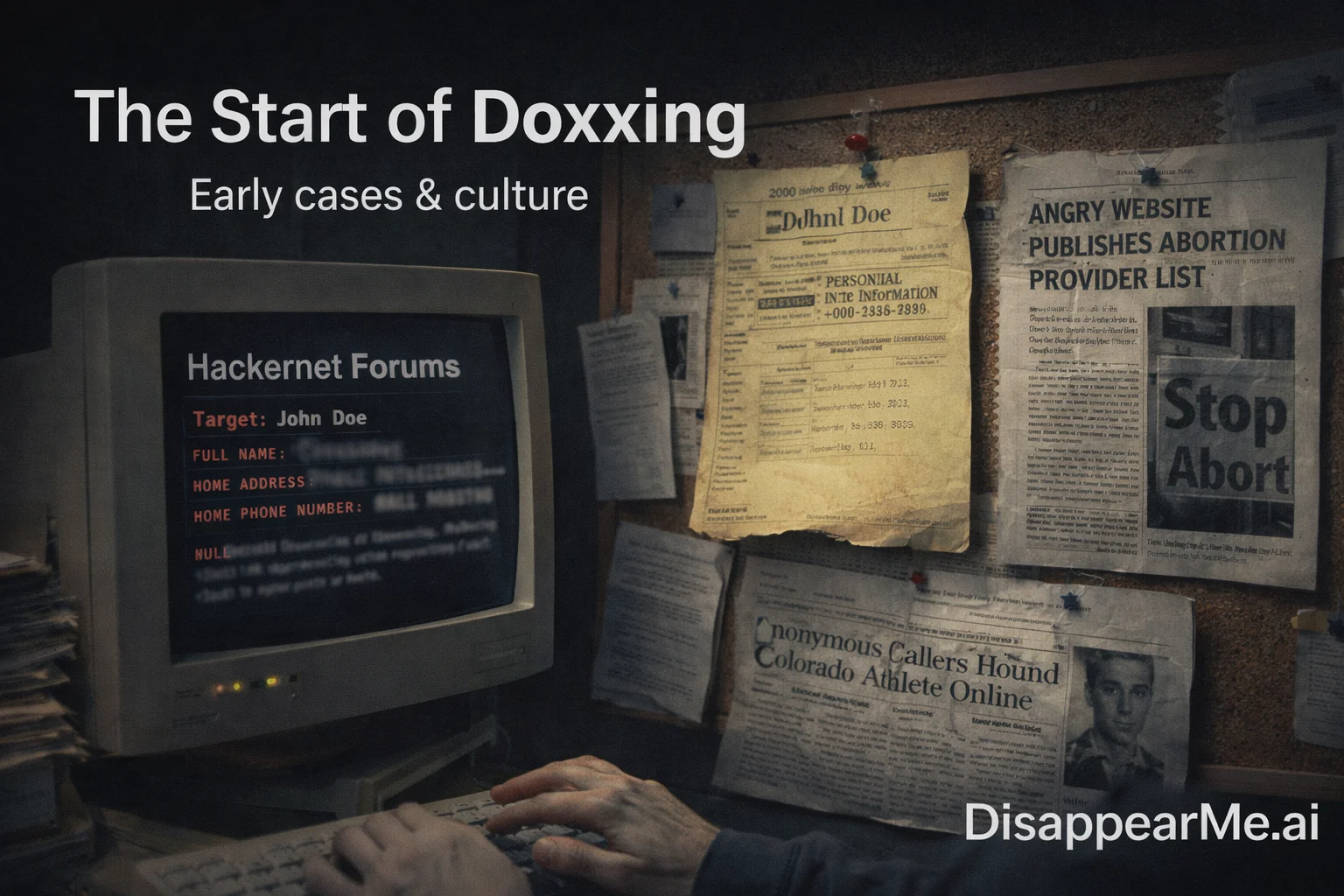
The Nuremberg Files Website:
- Launched in late 1990s (exact date debated)
- Published home addresses of abortion providers
- Included language implying visitors should "target" providers
- Included photos and personal details
- Resulted in actual murders of abortion doctors (Barnett Slepian, 1998)
Historical Significance:
The Usenet doxxing of the late 1990s represents the first major weaponization of internet identity exposure for organized harassment.
Why Usenet?
Usenet was a perfect vector for early doxxing because:
- Global reach (information spread worldwide instantly)
- Pseudonymous culture (hackers and activists)
- Weak moderation (no platform enforcement of rules)
- Permanent archives (posts indexed forever)
- Technical users (could execute sophisticated information gathering)
4chan: The Evolution (2003 Onward)
What Was 4chan?
- Anonymous image board launched 2003
- Built on principle of radical anonymity
- No user registration required
- No post history (threads deleted after time)
- Radical freedom of speech culture
- No moderation in early years
4chan and Doxxing (2003-2010s):
4chan became a center of doxxing activity:
- Early years: Individual doxxing (targeting specific people for revenge, exposure)
- Mid-2000s: Organized doxxing campaigns (groups coordinating to expose targets)
- 2008 onward: Project Chanology (Anonymous targeting Scientology leadership)
- 2010s: Coordinated harassment campaigns
Project Chanology (2008):
- Anonymous (hacker collective using 4chan) organized protest against Church of Scientology
- First major coordinated doxxing campaign
- Published names, addresses, personal information of Scientology leaders
- Organized physical protests at published addresses
- Set pattern for future coordinated harassment
Reddit: Mainstream Adoption (2010s)
The Platform:
- Founded 2005
- Grew to mainstream popularity 2010s
- Mixed real names (some users) and pseudonyms
- Subreddit-based organization
- User-moderated through upvoting/downvoting
- Archive of all content
Doxxing on Reddit:
- Subreddits dedicated to "identifying" people (r/FindBostonBomber, etc.)
- Individual subreddits engaging in harassment campaigns
- Users compiling dossiers on targets
- Cross-platform coordination (Twitter, YouTube, outside platforms)
The Violentacrez Case (2012):
- Adrian Chen (Gawker reporter) revealed identity of Reddit user "Violentacrez" (Michael Brutsch)
- Brutsch ran subreddits hosting sexualized photos of teenagers
- Chen published article revealing his real identity, workplace, and details
- Reddit users accused Chen of "doxxing" (though he was journalist exposing criminal behavior)
- Reddit users launched revenge campaign against Gawker
- Incident brought term "doxxing" into mainstream consciousness
PART 5: THE SHIFT TO MAINSTREAM (2010s-2020s)
Gamergate (2014): Doxxing Goes Mainstream
The Crisis:
- 2014 gaming industry harassment campaign
- Targeted women in gaming industry and game developers
- Organized harassment across Twitter, Reddit, 4chan, YouTube
- Coordinated doxxing of targets
The Scale:
- Thousands coordinated harassment campaign
- Victims received death threats, rape threats
- Personal information published widely
- Some victims forced to flee homes
- Some left industry entirely
Historical Significance:
Gamergate marked the transition from niche internet phenomenon to mainstream harassment tactic.
Why Mainstream?
- Social media integration (Twitter, YouTube)
- Mainstream media coverage
- Large numbers of participants
- Multiple coordinated platforms
- Professional consequences for victims (lost jobs, opportunities)
The Term Goes Mainstream (2014-2020)
Etymology Timeline:
- 1990s: "Dropping dox" used in hacker culture
- 2000-2005: Term recorded in early internet slang
- 2008: Urban Dictionary entry for "dox"
- 2011: Wikitionary entry added
- 2011: Doxbin launched (TOR site hosting dossiers)
- 2012: Violentacrez case brings term to mainstream
- 2014: Gamergate normalizes term in mainstream media
- 2017: New York Times article: "How 'Doxxing' Became a Mainstream Tool in Culture Wars"
- 2020: Mainstream dictionaries add definition
Popularization Drivers:
- Political polarization - Activists used doxxing for political targets
- Social media scale - Information spreads globally instantly
- Search engines - Personal information easily findable
- Media coverage - Journalists reporting on doxxing as phenomenon
- Coordinated campaigns - Black Lives Matter, January 6th, other movements
PART 6: THE INTERNET INFRASTRUCTURE THAT ENABLED DOXXING
Why Doxxing Was Inevitable: The Information Aggregation
The Key Innovation:
The internet didn't invent doxxing—it automated and scaled the process of aggregating publicly available information.
Pre-Internet Information Gathering:
To know someone's address and phone number, you needed:
- Access to directory services (phone books)
- Access to public records (property records, voter registration)
- Personal networks (people who knew them)
- Time and effort (days to weeks)
Internet Information Gathering:
To know someone's address and phone number, you need:
- Google search (seconds)
- Social media (reveals hometown, workplace, family members)
- Property record databases (online and indexed)
- Data brokers (Spokeo, BeenVerified—aggregated databases)
- Cross-reference tools (linking different databases)
- Time required: minutes
The Timeline Compression:
From days/weeks to minutes fundamentally changed the threat model.
The Anonymity Collapse
The Condition That Changed:
Early internet: Anonymity was default Modern internet: Real identity is default (social media, Google accounts)
Why Doxxing Became Powerful:
When anonymity was default, revealing someone's identity was shocking and damaging.
When real names are already public, doxxing adds one piece of information: physical location (home address).
The Shift:
- 1990s: Doxxing = "Here's who you really are"
- 2020s: Doxxing = "Here's where you live"
The threat model shifted from identity exposure to physical targeting.
PART 7: THE INFRASTRUCTURE OF MODERN DOXXING
The Data Architecture That Enables Doxxing (2025)
Information Sources Available to Doxxers:
-
Social Media (Primary Source)
- Facebook (real name, photos, location history, family members)
- Instagram (geotags, lifestyle, routines)
- LinkedIn (employment, location)
- Twitter/X (posts, location mentions)
- TikTok (videos with location data)
-
Data Brokers (Secondary Source)
- Spokeo (aggregated personal information)
- BeenVerified (background checks)
- Whitepages (addresses, phone numbers)
- Radaris (comprehensive profiles)
- 100+ other brokers
-
Public Records (Tertiary Source)
- Property records (home ownership)
- Court records (addresses, personal details)
- Voter registration (address, sometimes phone)
- Business filings (personal information)
-
Search Engines
- Google indexes all of the above
- Instant global distribution
- Permanent archival
The Aggregation Problem:
A single doxxer has to work to compile information from multiple sources.
But the internet has already aggregated it for them.
Data brokers sell profiles that combine:
- Social media information
- Public records
- Search engine history
- Compiled across decades
Why Doxxing Is Essentially Inevitable in 2025
The Fundamental Reality:
Most people's addresses are already public.
The average person in 2025:
- Is listed on multiple data brokers
- Has posted location information on social media
- Has property records online
- Is searchable on Google
- Has phone number available online
Doxxing Isn't Even Difficult:
Modern doxxing often requires:
- Search target's name on Google
- Search target on data broker sites
- Note address
- Publish address
That's it. No hacking required.
Why Doxxing Became Endemic:
In the 1990s: Doxxing required technical skill and access. In 2025: Doxxing requires basic search skills and a public platform.
Turn Chaos Into Certainty in 14 Days
Get a custom doxxing-defense rollout with daily wins you can see.
- ✓✅ Day 1: Emergency exposure takedown and broker freeze
- ✓✅ Day 7: Social footprint locked down with clear SOPs
- ✓✅ Day 14: Ongoing monitoring + playbook for your team
PART 8: THE EVOLUTION OF DOXXING JUSTIFICATIONS
How the Justification Changed
1990s Hacker Justification:
"He/she violated our community norms. De-anonymization is punishment."
Implied: Justifiable within hacker culture for enforcing norms.
Late 1990s Activist Justification:
"We're exposing neo-Nazis and abortion providers to prevent violence."
Implied: Vigilante justice is necessary when system fails.
2000s-2010s Internet Culture:
"We're outing hypocrites, predators, and bad people."
Implied: Internet mob is moral justice.
2010s-2020s Political Justification:
"Our political opponents are enemies. Doxxing is justified."
Implied: Political war justifies extreme tactics.
2020s-2025 Normalization:
"Doxxing is now a standard harassment tactic."
Implied: No longer questioned; accepted as part of online culture.
The Moral Collapse
The Argument:
Doxxing started with justification: "We're exposing bad people."
Over time, the justification became irrelevant.
Modern Reality:
People are doxxed for:
- Expressing political opinions
- Playing certain video games
- Being associated with controversial organizations
- Being in wrong place at wrong time
- Existing in wrong community
The Justification is Abandoned:
Modern doxxers often don't bother justifying. The tactic has become accepted.
PART 9: LEGALLY GRAY STATUS - From Hacker Culture to Criminal
The Legal Evolution
1990s Status:
Doxxing was legally ambiguous:
- Was it illegal to publish public information?
- Was it harassment? Defamation? Incitement?
- Different jurisdictions answered differently
2000s-2010s Status:
Courts began addressing doxxing:
- Some cases prosecuted as harassment
- Some as cyberstalking
- Some as threats
- Inconsistent legal treatment
2010s-2020s Status:
Legislatures began passing anti-doxxing laws:
- Virginia passed specific anti-doxxing law
- Other states followed
- Federal laws proposed but not passed
- Legal status varies by jurisdiction
Free Speech Complication:
Anti-doxxing laws face First Amendment questions:
- Publishing public information is arguably protected speech
- Drawing line between "journalism" and "doxxing" is ambiguous
- Some countries restrict more than others
- No universal legal standard
The Current Legal Reality (2025)
Doxxing is:
- Illegal in some jurisdictions (Virginia, some others)
- Prosecutable as harassment/cyberstalking in many jurisdictions
- Civil liability possible (harassment, invasion of privacy)
- Largely unprosecuted (very few prosecutions)
Doxxing is:
- NOT illegal at the federal level in the US
- NOT universally illegal across all states
- Often not prosecuted even where illegal
- Rarely results in significant punishment
PART 10: THE ROLE OF DISRUPTION AND IDEOLOGY
Anonymous and Organized Doxxing Campaigns
Who Is Anonymous?
- Not a formal organization
- Loose collective of internet users and hackers
- Self-identified by Guy Fawkes masks (after V for Vendetta)
- Emerged from 4chan culture mid-2000s
- Used for both activist and harassment campaigns
Anonymous Doxxing Campaigns:
- Project Chanology (2008): Targeted Church of Scientology leadership
- HBGary Federal (2011): Hacked security firm, released employee information
- Occupy Wall Street (2011-2012): Doxxed KKK members, others
- **Various:**Targeted government officials, corporations, individuals
The Pattern:
Anonymous adopted doxxing as tactic for:
- Exposing what they viewed as wrongdoers
- Organizing coordinated protests
- Destroying targets' lives and careers
- Enabling physical harassment
The Evolution:
Early Anonymous campaigns claimed moral justification: "We're fighting corruption."
Later Anonymous: Doxxing became standard tactic for any targeted group.
Most recent: Anonymous rhetoric dominates many online spaces; doxxing considered normal.
PART 11: THE HISTORICAL LESSONS
How We Got Here: The Internet's Trajectory
The Original Internet Vision:
The internet was supposed to be:
- Decentralized, free from central authority
- Pseudonymous, protecting privacy
- Open, free speech enabled
- Empowering to individuals and activists
What Happened:
- Centralization occurred (Google, Facebook, Amazon, AWS control infrastructure)
- Anonymity eroded (real names now default)
- Free speech weaponized (as tool of harassment rather than liberation)
- Power consolidated (platforms control speech, governments control platforms)
Doxxing's Role:
Doxxing is the convergence of internet history:
- Hacker culture's ethos of de-anonymization as punishment
- Activist tradition of exposing wrongdoers
- Internet-enabled information aggregation
- Social media's real-name culture
- Platform algorithms amplifying harassment
- Political polarization weaponizing the tactic
The Unintended Consequence:
The internet designers' vision of freedom accidentally created the infrastructure for mass harassment.
The 1990s vs. 2025 Comparison
| Factor | 1990s Doxxing | 2025 Doxxing |
|---|---|---|
| Source | Hacker culture, niche | Mainstream, organized |
| Speed | Days (required effort) | Minutes (automated) |
| Scale | Dozens to hundreds | Millions globally |
| Infrastructure | Manual effort | Automated data aggregation |
| Information | Difficult to find | Easily publicly available |
| Target | Usually deserving (in perpetrator's view) | Anyone, no justification needed |
| Consequence | Exposure, shame | Physical threats, violence |
| Legal status | Ambiguous | Still largely unprosecuted |
| Cultural acceptance | Niche, controversial | Normalized, routine |
PART 12: FREQUENTLY ASKED QUESTIONS ABOUT DOXXING HISTORY
Q: Is doxxing really from the 1990s?
Answer: The term and formalized practice emerged in the 1990s from hacker culture, but the tactic (publishing personal information to shame or threaten someone) predates the internet.
What's new is not the impulse; it's the infrastructure.
Q: Why did the early internet enable doxxing?
Answer: Three converging factors:
- Radical anonymity was the default, making de-anonymization shocking
- Global distribution meant information spread worldwide instantly
- Permanent archival (search engines) made information retrievable forever
Pre-internet, publishing someone's address in a newspaper reached hundreds. Internet, it reaches millions.
Q: Was 4chan responsible for doxxing becoming mainstream?
Answer: 4chan was a major vector, but not solely responsible.
4chan provided infrastructure and culture for organized doxxing, but:
- Reddit adopted doxxing practices
- Twitter/social media enabled mass coordination
- Data brokers made information easily available
- Search engines indexed everything
Mainstream adoption came from many vectors combining.
Q: Did Anonymous invent modern coordinated doxxing?
Answer: Anonymous popularized organized, collective doxxing campaigns, but didn't invent the practice.
Project Chanology (2008) was one of the first major coordinated multi-platform campaigns, but individual doxxing predated it.
Q: Why isn't doxxing illegal everywhere?
Answer: Multiple reasons:
- Free speech concerns - Publishing public information arguably protected
- Definition ambiguity - Hard to distinguish "journalism" from "doxxing"
- Jurisdiction challenges - Internet is global; laws are local
- Enforcement difficulty - Anonymous doxxers hard to prosecute
- Political will - Low priority for law enforcement
Q: Is doxxing worse now than in the 1990s?
Answer: Incomparably worse.
- 1990s: Thousands affected (hacker community, Usenet activists)
- 2025: Millions affected, mainstream threat
The scale, speed, and consequences have multiplied exponentially.
Q: How is doxxing related to the loss of internet anonymity?
Answer: Direct cause and effect:
- 1990s: Anonymity was default; de-anonymization was rare and shocking
- 2025: Real identity is default; doxxing now means publishing address/phone
The threat model changed from "you're exposed as a real person" to "here's where you live physically."
Q: What's the DisappearMe.AI role in this history?
Answer: DisappearMe.AI is a response to the current phase of doxxing history.
The infrastructure (data brokers, search engines, social media) that enables doxxing also enables preventive action.
DisappearMe.AI removes people from the data infrastructure before doxxers can weaponize it.
CONCLUSION: From Hacker Culture to Crisis
The Historical Arc
Doxxing emerged from hacker culture's value of anonymity as a radical threat.
When a hacker's identity was revealed, everything was at stake: legal exposure, community reputation, safety.
Revealing that identity was "dropping dox"—the nuclear option.
The Democratization
Over 30 years, doxxing went from niche hacker tactic to mainstream harassment tool.
Not because the impulse changed, but because:
- The infrastructure for information aggregation was created
- The internet became public (not just hacker elite)
- Real identity became mandatory (not optional)
- Search engines indexed everything
- Coordinated campaigns became possible
The Current Crisis
In 2025, doxxing is:
- Endemic (affecting millions annually)
- Normalized (accepted practice in many online communities)
- Largely unprosecuted (few legal consequences)
- Partially preventable (through data removal)
The Lesson
The internet was supposed to liberate. Instead, the same infrastructure that enabled liberation enabled mass harassment.
Understanding doxxing's history—from hacker revenge tactic to systematic threat—is essential to understanding how we got here and what we can do about it.
Threat Simulation & Fix
We attack your public footprint like a doxxer—then close every gap.
- ✓✅ Red-team style OSINT on you and your family
- ✓✅ Immediate removals for every live finding
- ✓✅ Hardened privacy SOPs for staff and vendors
References
-
Wikipedia. (2012). "Doxing." Retrieved from https://en.wikipedia.org/wiki/Doxing
-
Fortinet. (2024). "What Is Doxing? What Does It Mean to Dox Someone?" Retrieved from https://www.fortinet.com/resources/cyberglossary/doxing
-
Kaspersky. (2025). "What is Doxing? Definition and Explanation." Retrieved from https://usa.kaspersky.com/resource-center/definitions/what-is-doxing
-
The Foundation for Individual Rights and Expression (FIRE). (2023). "Is doxxing illegal? — Doxxing, free speech, and the First Amendment." Retrieved from https://www.thefire.org/research-learn/doxxing-free-speech-and-first-amendment
-
Malwarebytes. (2024). "What is Doxxing?" Retrieved from https://www.malwarebytes.com/doxxing
-
Besedo. (2023). "What Is Doxxing and How Do You Prevent It?" Retrieved from https://besedo.com/blog/what-is-doxxing/
-
Bloomberg. (2020). "Where Doxxing Came From and Why It Keeps Popping Up: QuickTake." Retrieved from https://www.bloomberg.com/news/articles/2020-07-30/where-doxxing-came-from-and-why-it-keeps-popping-up-quicktake
-
The Atlantic. (2014). "Doxing: An Etymology." Retrieved from https://www.theatlantic.com/technology/archive/2014/03/doxing-an-etymology/284283/
-
Dictionary.com. (2025). "DOX Definition & Meaning." Retrieved from https://www.dictionary.com/browse/dox
-
The New York Times. (2017). "How 'Doxxing' Became a Mainstream Tool in the Culture Wars." Retrieved from https://www.nytimes.com/2017/08/30/technology/doxxing-protests.html
About DisappearMe.AI
DisappearMe.AI provides comprehensive privacy protection services for high-net-worth individuals, executives, and privacy-conscious professionals facing doxxing threats. Our proprietary AI-powered technology permanently removes personal information from 700+ databases, people search sites, and public records while providing continuous monitoring against re-exposure. With emergency doxxing response available 24/7, we deliver the sophisticated defense infrastructure that modern privacy protection demands.
Protect your digital identity. Contact DisappearMe.AI today.
<!-- seo-engine:related-reading:start -->Related Reading
- The Complete History of Doxxing: From 1990s Hacker Culture to 2025 Epidemic (Origins, Evolution, Impact, and Prevention)
- Doxxing: The Complete Institutional Analysis - Definition, Tactics, Victims, Consequences, the Escalating Crisis in 2025, and Why It's Become a Weapon of Modern Warfare (Not a How-To)
- The Digital Violence Crisis Against Women 2025: Why 1.8 Billion Women Lack Protection, How Data Exposure Enables Abuse, AI Deepfakes and Revenge Porn as Weapons, and Why Mothers, Professionals, and Activists Need DisappearMe.AI Right Now
Take the Next Step
If you want DisappearMe.ai to handle the database deletion wave and ongoing leakage monitoring for you, start with a Contact and review Free exposure audit.
<!-- seo-engine:next-step:end --> <!-- seo-engine:faq:start -->Frequently Asked Questions
What should I do in the first hour after being doxxed?
Preserve evidence, tighten the accounts tied to the exposed data, and start removing the databases, people-search pages, and search results that make the exposure easy to reuse.
Can DisappearMe.ai help if my family was exposed too?
Yes. Household exposure usually travels through relatives, historical addresses, and shared records, so the cleanup plan should cover every connected person that attackers can pivot to.
How fast can emergency cleanup start?
The first deletion wave can start immediately after intake, but the important part is sequencing the highest-risk exposures first and then monitoring for reposts or relistings.
<!-- seo-engine:faq:end --> <!-- seo-engine:references:start -->References and Further Reading
<!-- seo-engine:references:end -->Related Articles
The Digital Violence Crisis Against Women 2025: Why 1.8 Billion Women Lack Protection, How Data Exposure Enables Abuse, AI Deepfakes and Revenge Porn as Weapons, and Why Mothers, Professionals, and Activists Need DisappearMe.AI Right Now
1 in 4 women experience digital abuse. 1.8B lack legal protection. AI deepfakes targeting women leaders. 40% countries no cyberstalking laws. Women need DisappearMe.AI protection now.
Read more →Doxxing: The Complete Institutional Analysis - Definition, Tactics, Victims, Consequences, the Escalating Crisis in 2025, and Why It's Become a Weapon of Modern Warfare (Not a How-To)
11M Americans doxxed. 93% worry about doxxing. Escalating 2025 crisis. PTSD, job loss, stalking, violence. Doxxing definition, tactics, impact, statistics, and why DisappearMe.AI protection matters.
Read more →The Complete History of Doxxing: From 1990s Hacker Culture to 2025 Epidemic (Origins, Evolution, Impact, and Prevention)
Complete doxxing history: from 1990s hacker origins ('dropping dox') through Usenet, 4chan, Anonymous, Gamergate to 2025. Learn what doxxing is, why it evolved, who gets doxxed, legal status, and how to prevent it with DisappearMe.AI.
Read more →