Political & Donor Privacy: Protecting Your Support Without Doxxing Yourself (2025 Election Cycle Guide)
Emergency Doxxing Situation?
Don't wait. Contact DisappearMe.AI now for immediate response.
Call: (646) 484-9051
Email: oliver@disappearme.ai
Our team responds within hours to active doxxing threats.
PART 1: THE POLITICAL PRIVACY CRISIS - How Your Vote and Donations Became Public Records
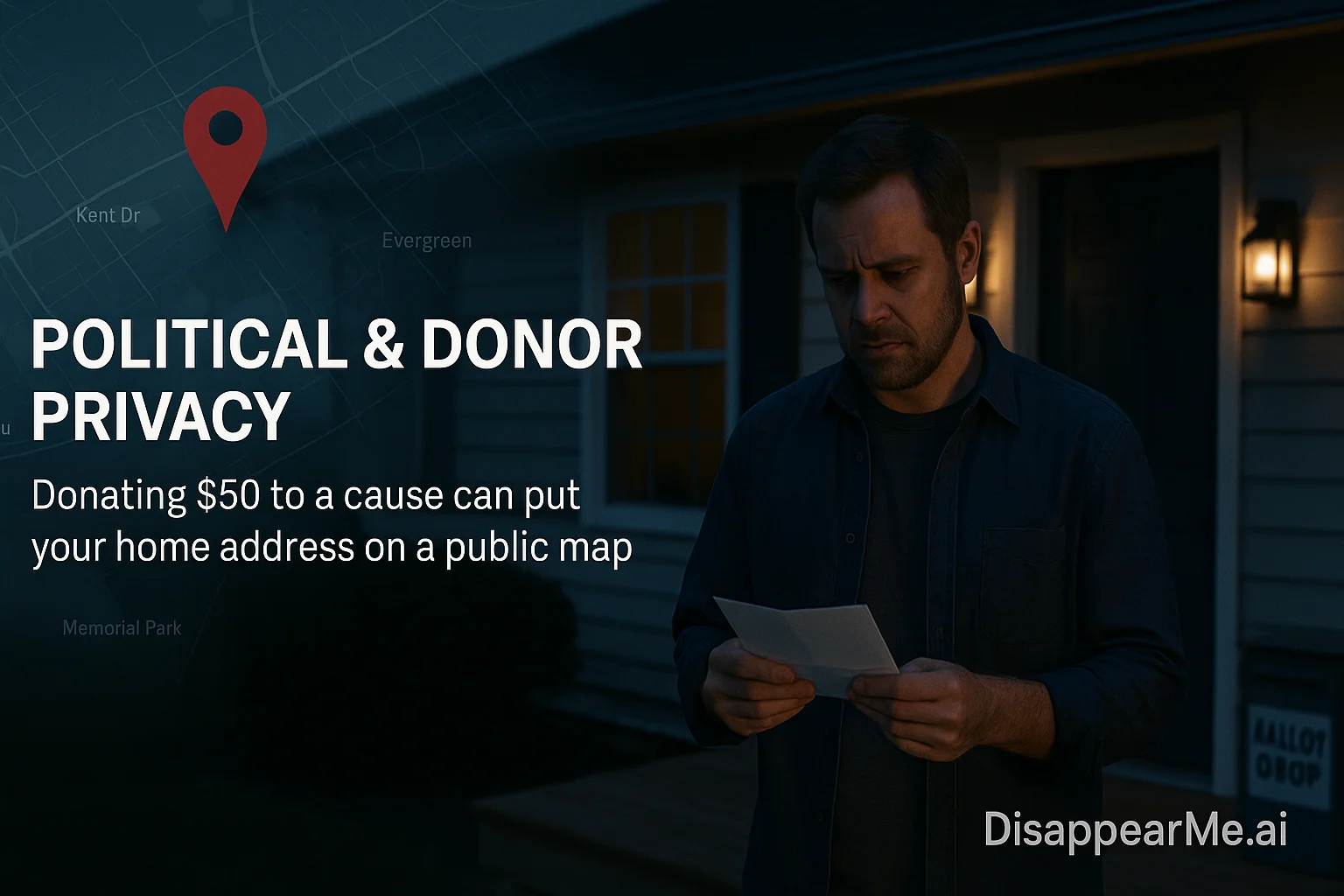
The FEC Disclosure Requirement: Your $50 Donation Is Now Public Information
When you donate to a federal political candidate, campaign committee, or Super PAC, your donation becomes part of a federal public record—accessible to anyone with internet access, indexed by Google, compiled by data brokers, and used by political campaigns, private investigators, and people with various intentions toward you.
<!-- seo-engine:intro-bridge:start -->If you want companion reads while you work through this topic, start with The Genetic Privacy Crisis of 2025: Why Your DNA Is Being Sold (And How to Disappear Before It's Too Late) and HIPAA for Privacy: Medical Professionals, Lawyers & Healthcare Workers - Privacy Protection Beyond Patient Data (Doxxing & Harassment Protection Guide). If you want a done-for-you plan, book a free exposure audit.
<!-- seo-engine:intro-bridge:end -->How FEC Disclosure Works:
The Federal Election Campaign Act (FECA) requires that all federal donations be disclosed. Here's the process:
- Your donation is collected - You give money to a candidate, campaign committee, or political organization
- Your information is recorded - The recipient records your name, address, occupation, employer, and donation amount
- Reports are filed - The recipient files disclosure reports with the Federal Election Commission within specific timeframes
- Data becomes public - Within days or weeks, your donation appears in FEC databases
- Data is distributed - Google indexes it, data brokers scrape it, political campaigns analyze it, journalists access it
- Permanent record - Your donation remains publicly searchable indefinitely
What Gets Disclosed:
For donations exceeding $50, the FEC requires disclosure of:
- Your name
- Your home address (complete street address, city, state, ZIP)
- Your occupation
- Your employer name
- Your donation amount
- Date of donation
- Candidate or committee receiving the donation
For donations exceeding $200 in an election cycle, the disclosure requirements are even more detailed.
The Scale of the Exposure:
- 5+ million individual donations disclosed annually - Your name among millions of publicly searchable records
- FEC.gov receives 10+ million searches monthly - People actively searching donor records
- Data broker inclusion - Your donation is scraped and resold by commercial data brokers
- Search engine indexing - Google indexes your name + donation amount + home address together
- Permanent record - FEC data never gets deleted; donations from decades ago are still searchable
- Cross-platform aggregation - Your donation is combined with voter registration, social media, and other data to create comprehensive profile
The Personal Risk:
Once your donation is public, you become vulnerable to:
- Political Harassment - People who disagree with your politics can find your address and contact you
- Employment Risk - Your employer can see your political donations (some employers retaliate against employees for political views)
- Targeted Vandalism - Physical attacks on homes of donors to unpopular causes (documented in 2024 election cycle)
- Social Media Doxxing - Your donation is combined with your social media presence to create harassment campaigns
- Stalking and Targeting - Extremists use donor lists to target specific individuals
- Relationship Exposure - Family members, friends, and colleagues discover your political beliefs
Specific Risk Scenarios:
- In a contentious relationship: Donating to candidates your ex-partner opposes becomes leverage in custody battles
- In politically polarized workplaces: Donations to certain candidates become grounds for discrimination or termination (depending on laws in your state)
- In small towns: Your donations become community gossip that affects relationships with neighbors
- In competitive industries: Competitors research your donations to understand your political connections
- For high-profile individuals: Your political donations become news stories and social media targets
Voter Registration Rolls: The #1 Source of Junk Mail and Stalking
Beyond campaign donations, voter registration itself is a massive privacy vulnerability. Voter registration records are maintained by 50 states and are mostly public.
What Voter Registration Rolls Contain:
States publish the following information for most voters:
- Full name
- Home address
- Date of birth
- Phone number (in some states)
- Email address (in some states)
- Party affiliation (in some states)
- Voting history (whether you voted in past elections, in some states)
- Driver's license number (in some states)
The Publication Scale:
- 160+ million active voters in the United States
- All 50 states publicly distribute voter registration records (with limited exceptions)
- Records sold to political campaigns - Candidates buy your voter file
- Records sold to data brokers - Commercial companies aggregate and resell voter data
- Records sold to marketers - Direct mail campaigns use voter data
- Records accessible to anyone - You can download entire state voter rolls for minimal cost
Who Uses Voter Registration Data:
- Political campaigns - Building voter contact databases, voter targeting
- Data brokers - Aggregating with other data to sell comprehensive profiles
- Direct mail companies - Sending unsolicited political mail
- Debt collectors - Using voter records to locate people
- Private investigators - Finding people for various purposes
- Scammers and fraudsters - Targeting people for financial fraud
- Bad actors - Using records to locate, harass, or target individuals
The Practical Impact:
Once you register to vote:
- Junk mail explodes - Political organizations send you direct mail based on your party registration and demographic profile
- Phone calls increase - Campaign volunteers call you (often at dinner time)
- Voter targeting becomes possible - Campaigns micro-target you based on voter profiling
- Your information is aggregated - Voter data combined with social media, purchase history, location data to create detailed profile
- Stalking becomes possible - Estranged partners, abusers, or bad actors use voter registration to find you
- Harassment campaigns - Political opponents can use your voter file to organize contact campaigns
Special Vulnerability: Domestic Violence and Stalking Victims
For people fleeing abusive situations, voter registration records are a critical vulnerability. Abusers can use public voter records to find victims they're attempting to locate.
This is why all 50 states offer Confidential Voter Registration (also called Address Confidentiality Programs or ACP), which allows victims to vote without appearing on public voter rolls.
Jury Duty: The Public Records Exposure Most People Don't Expect
Jury duty creates another significant privacy exposure: your juror information becomes part of court records, which are mostly public.
What Happens to Your Juror Information:
When you're selected for jury duty:
- Jury questionnaires - You complete written questions about your background, experiences, beliefs, and personal circumstances
- Voir dire proceedings - Attorneys question you in open court about your ability to be impartial
- Information collection - Your name, address, employer, occupation, and sensitive personal information are documented
- Court records creation - All of this information is entered into court dockets and records
- Public records - Most of this information becomes available to the public (with limited exceptions)
What Gets Exposed:
Depending on the court and case, juror information can include:
- Name and address
- Employment information
- Answers to voir dire questions (which may reveal:
- Mental health history
- Substance abuse history
- Criminal history
- Marital problems
- Financial issues
- Medical conditions
- Sexual orientation
- Beliefs about specific topics)
- Juror names in court transcripts
- Juror information in news coverage of the trial
The Personal Risk:
Once this information is in court records:
- Permanent record - Court records never expire; information persists indefinitely
- Search engine indexing - Google may index court documents containing your information
- Media coverage - Reporters may include juror information in trial coverage
- Juror retaliation - In controversial cases, jurors face harassment based on their jury role
- Employment concerns - Employers may discover sensitive information revealed in voir dire
- Public exposure of private information - Sensitive personal circumstances become public record
Specific Risk Scenarios:
- In high-profile cases - Your jury service becomes public knowledge, potentially making you a target for harassment
- In controversial cases - Activists may research jurors and organize campaigns around their verdict
- For sensitive disclosures - Information about mental health, substance abuse, or other sensitive topics becomes permanently public
- For employment - Some employers discriminate against employees based on jury verdicts or juror information
- For jury members in future cases - Your juror questionnaires from past cases may follow you to future jury service
The Trump Cases (2024-2025) Example:
In high-profile cases, juror privacy has become a major concern. Courts have begun restricting juror information access, but the balance between public trial rights and juror privacy remains contentious.
PART 2: THE FEC LOOPHOLE - How Political Donations Can Avoid Public Disclosure
While federal law requires disclosure of most campaign donations, there are legal structures that allow donations to be made with significantly more privacy. Understanding these is critical for anyone who wants to support political causes while maintaining privacy.
Important Note: This guide explains how FEC disclosure rules work and what options exist. Which options are right for you depends on your goals, risk tolerance, and financial situation. This is presented for informational purposes; consult a campaign finance attorney for specific guidance.
Understanding the $50 Threshold
The FEC requires disclosure of individual donations exceeding $50. Donations of $50 or less do not require disclosure of donor identity.
How This Creates Privacy Opportunities:
- Multiple $50 donations - Instead of donating $500 to one candidate (creating one disclosure record), donate $50 at a time to 10 different fundraisers (avoiding disclosure threshold on any single instance)
- Donations to multiple accounts - The $50 threshold applies per-donation, not per-donor-per-candidate. Different committee accounts are separate
- Coordination challenges - While possible, coordinating multiple $50 donations to avoid disclosure is legally risky (campaign finance law prohibits coordination to evade disclosure)
The Limitation: This works for small donations. For significant financial support, the $50 threshold strategy isn't practical.
Super PACs and Undisclosed Donations
Super PACs (political action committees that can accept unlimited donations) are governed by different disclosure rules than candidate committees.
How Super PACs Work:
- Super PACs can accept unlimited donations from individuals and corporations
- Super PACs must disclose donations exceeding $200 (same as candidate committees, lower threshold)
- Super PACs cannot coordinate with candidates (they operate "independently")
- Super PACs use the disclosed donations to run political advertisements and conduct campaigns
The Loophole: Donations to Super PACs' Donors
While Super PACs must disclose who donates to them, the original source of the money is not required to be disclosed.
Here's how this creates privacy:
- You donate to a pass-through entity (sometimes a nonprofit, sometimes a corporation) - Your donation to the pass-through is not disclosed
- The pass-through donates to the Super PAC - The Super PAC discloses the pass-through entity, not you
- The Super PAC runs campaigns - Your money supports the campaign, but your identity is not publicly disclosed
This is called "dark money" - donations that fund political campaigns without disclosing the original donor.
501(c)(4) Organizations and Dark Money
The most common structure for undisclosed political donations is 501(c)(4) social welfare organizations.
How 501(c)(4) Dark Money Works:
- You donate to a 501(c)(4) nonprofit - This donation is NOT publicly disclosed (501(c)(4)s are not required to disclose donors)
- The 501(c)(4) makes political contributions - These contributions may go to Super PACs, candidates, or be used directly for political advertising
- Political spending is conducted - Your money funds the campaign, but you remain completely anonymous
- No public record of your involvement - Your donation and your identity are never disclosed
Why This Works Legally:
- 501(c)(4) organizations are classified as nonprofits that can engage in political activity
- IRS rules do not require 501(c)(4)s to disclose their donors to the public
- Tax returns (Form 990) are public, but don't require disclosure of individual donors
- This is legal and has been upheld by courts
The Scale of Dark Money:
- $1 billion+ in dark money donations in 2024 election cycle (estimated)
- Increasing trend - Dark money donations have increased dramatically since Supreme Court's Citizens United ruling (2010)
- Both sides use it - Democrats and Republicans both use 501(c)(4) structures for undisclosed donations
- Multinational corporations and wealthy individuals are major sources of dark money
How to Make a Private Donation (Legal Structures)
If you want to support a political cause while maintaining privacy, here are legal options:
Option 1: Donate Under $50
- How: Donate $50 or less at a time
- Privacy: Your donation is not disclosed
- Limitations: Only works for small donations; multiple donations to same candidate require aggregation for legal purposes
- Cost: None
- Ease: Very easy
Option 2: Donate Through a 501(c)(4)
- How: Donate to a nonprofit 501(c)(4) organization that supports causes you care about
- Privacy: Your donation to the 501(c)(4) is not disclosed; the 501(c)(4) uses the money for political activities
- Limitations: You don't control exactly how the money is used; 501(c)(4) decides how to spend it
- Cost: Varies; some 501(c)(4)s have minimum donations
- Ease: Easy if you find a 501(c)(4) supporting your cause
Option 3: Donate Through a Donor-Advised Fund (DAF)
- How: Establish a donor-advised fund at a financial institution, donate to it, then recommend grants to causes you support
- Privacy: Your donation to the DAF is not public; your grant recommendations to political organizations may or may not be disclosed depending on the DAF structure
- Limitations: More complex than direct donation; limited to certain causes; DAF sponsors may restrict political donations
- Cost: Setup and management fees
- Ease: Moderate; requires working with financial advisor
Option 4: Donate Anonymously Through a Person
- How: Give money to someone you trust who then donates in their own name
- Privacy: You remain completely anonymous; your trusted person appears as the donor
- Limitations: Legally risky (may violate straw donor laws if coordination is inferred); requires trust relationship
- Cost: None
- Ease: Easy but potentially illegal
Important Legal Caveat: Federal election law prohibits "straw donor" arrangements where you give money to someone else specifically to donate in their name to evade disclosure. The line between legitimate anonymity and illegal straw donation is legally complex. Consult a campaign finance attorney before using any of these strategies if the donation is substantial.
The Limits of Privacy
Even with these legal structures, privacy has limits:
- Bank records - Your bank will have a record of your donation
- Tax implications - Large donations may have tax consequences documented on your return
- Communication records - If you communicate about the donation, those communications may be discoverable
- Investigation exposure - If there's a campaign finance investigation, you may be identified despite privacy structures
- Personal integrity - You must be comfortable with the donation being traced to you if subpoenaed or investigated
PART 3: CONFIDENTIAL VOTER REGISTRATION - How to Protect Your Address from Voter Rolls
If you're concerned about appearing on public voter registration rolls, all 50 states offer some form of voter privacy protection. The most comprehensive option is "Confidential Voter" status, which is available to domestic violence and stalking victims in all states.
What Is Confidential Voter Status?
Confidential Voter status (also called Address Confidentiality Programs, or ACPs) allows you to register to vote without your address appearing on public voter rolls.
How It Works:
- You apply for Confidential Voter status - Through your state's election board
- You must qualify - You must attest that you are:
- A victim of domestic violence, sexual assault, human trafficking, stalking, or kidnapping (varies by state), OR
- At risk of harassment, persecution, or violence
- You receive a substitute address - Your voter registration uses a substitute address (typically a PO box or government address) instead of your home address
- Your physical address is protected - Your real address is withheld from public voter rolls
- You can still vote - You receive voter materials at your protected address or use alternative voting methods
What Gets Protected:
- Your home address does NOT appear on public voter rolls
- Your registration IS still on voter rolls (so you can vote)
- Election officials have access to your real address (for election administration purposes)
- Your name still appears on voter rolls (with the substitute address)
What Doesn't Get Protected:
- Your voter registration information is still partially public (your name appears)
- Other public records (driver's license, property records) still contain your address
- Your voter file is still accessible to political campaigns (though with protected address)
- You must re-apply periodically (typically every 4 years)
How to Apply for Confidential Voter Status
Step 1: Check Your State's Requirements
Each state has slightly different requirements and application processes. Check your state's election board website for specific guidance.
General Requirements Across Most States:
- You must be a victim of:
- Domestic violence, or
- Sexual assault, or
- Stalking, or
- Trafficking, or
- Other serious crimes or threats
- You must provide documentation or attestation of your victim status
- Some states require police reports; others accept self-attestation
- Some states require approval from a victim advocacy organization
Step 2: Gather Documentation
You will likely need one or more of the following:
- Police report - If you've reported the crime/threat to police (strongest documentation)
- Protective order - If you have a restraining order or order of protection
- Letter from victim advocate - From a domestic violence shelter or victim services organization
- Medical records - Documenting injuries from violence
- Self-attestation - A written statement that you are in danger (accepted in many states)
If you don't have formal documentation, contact a domestic violence shelter or victim advocacy organization in your state. They can:
- Verify your status
- Provide documentation for the election board
- Help you complete the application
- In some states, provide the attestation themselves
Step 3: Obtain the Application Form
Go to your state's election board website and download the Confidential Voter or Address Confidentiality Program application form.
State-by-state resources:
- New York: NYS Board of Elections > "Confidential Voter" form
- California: CA Secretary of State > Address Confidentiality Program
- Texas: TX Secretary of State > Address Confidentiality Program
- Other states: Search "[your state] confidential voter" on your election board website
Step 4: Complete the Application
Fill out the form, which typically requires:
- Your name
- Your current address (this will be protected)
- Reason for requesting confidentiality (domestic violence, stalking, etc.)
- Attestation that you are in danger or a victim of qualifying crime
- Certification by victim advocate or self-certification (depending on state)
Step 5: Submit Your Application
Submit the form to your county board of elections. Methods vary by state:
- Mail - Send to the address on the form
- In person - Visit the election office with documentation
- Online - Some states allow electronic submission
Step 6: Await Approval
- Processing time: Typically 1-4 weeks
- Notification: Election board will send you confirmation
- Your substitute address: You'll receive information on your protected address for voter materials
- Voting information: You'll receive voting materials at your protected address or alternative location
Step 7: Register to Vote (If Not Already Registered)
If you're not already registered, register after receiving your Confidential Voter approval:
- By mail - Submit voter registration form with your protected address
- Online - Use your state's online voter registration with your protected address
- In person - Visit election office with your approval documentation
Step 8: Re-Apply When Status Expires
Most states require re-application every 4 years (at election renewal):
- Automatic renewal: Some states automatically renew your status
- Manual re-application: Others require you to re-apply
- Check your approval letter for instructions on renewal
Limitations of Confidential Voter Status
While Confidential Voter status is valuable, it has important limitations:
- Your name is still public - Your voter registration shows your name (just with protected address)
- Doesn't protect other public records - Your address appears on driver's license, property records, etc.
- Doesn't protect donation disclosures - FEC donations would still show your real address (you'd need separate protection)
- Political campaigns still see you - Your voter file is still available to campaigns (with your protected address)
- Not universal privacy - This only affects voter registration; other government databases aren't affected
Other Voter Privacy Options (State-Specific)
Beyond Confidential Voter status, some states offer additional privacy protections:
Mail-in Voting
- Many states allow victims to request mail-in ballots
- Ballots are sent to your protected address
- You vote in private without going to polling locations
Curbside Voting
- Some states allow disabled or vulnerable voters to remain in their car
- Election officials bring ballots to you
- More privacy than standing in line at polling places
Address Confidentiality Program (ACP) - Broader Version
- Some states offer broader ACP that covers multiple public records
- Protects address across driver's license, voter registration, property records (varies by state)
- Usually more restrictive eligibility than Confidential Voter status
Turn Chaos Into Certainty in 14 Days
Get a custom doxxing-defense rollout with daily wins you can see.
- ✓✅ Day 1: Emergency exposure takedown and broker freeze
- ✓✅ Day 7: Social footprint locked down with clear SOPs
- ✓✅ Day 14: Ongoing monitoring + playbook for your team
PART 4: JURY DUTY AND PUBLIC RECORDS - Minimizing Exposure in the Court System
Jury service creates privacy exposure that most people don't anticipate. Understanding your options for minimizing this exposure is critical.
What Juror Information Becomes Public
When you're called for jury duty, the following information may become part of public court records:
Jury Selection Information (Voir Dire):
- Your name
- Your address
- Your employment
- Your occupation
- Your age/date of birth
- Responses to attorney questions about bias, beliefs, experiences
- Information about your personal circumstances (mental health, criminal history, marital status, finances, etc.)
If You're Selected as a Juror:
- Your name may appear in jury instructions
- Your presence may be noted in court records
- Trial coverage may identify you
- Your verdict may be associated with you
If You're Part of a High-Profile Case:
- News media may identify you
- Social media campaigns may target you
- Your personal information may be posted publicly
- You may face harassment from people unhappy with the verdict
Strategies for Minimizing Jury Duty Exposure
Strategy 1: Request Private Voir Dire Questioning
When you receive your jury summons, consider requesting that your voir dire questioning be conducted privately (in judge's chambers or with limited people present).
How:
- Write a letter to the court explaining your privacy concerns
- Request that your questioning be conducted with only the judge, attorneys, and court personnel present
- Explain that you have concerns about public exposure of personal information
Why Courts May Grant This:
- Growing concerns about juror safety and privacy
- Legitimate privacy interests
- Reduced likelihood of juror withholding information
Limitations:
- Courts may deny the request (no absolute right to private voir dire)
- Even if private questioning is granted, your information may still be in written records
- High-profile cases may override your privacy request
Strategy 2: Request Redaction of Your Information
If you're selected as a juror, request that your personal information be redacted from public court documents.
How:
- Speak with the judge or court clerk after selection
- Explain your privacy concerns
- Request that your address, employment, and sensitive personal information be redacted from public documents
Why Courts May Grant This:
- Established practice in high-profile cases
- Valid privacy interests
- Does not interfere with public trial rights
Limitations:
- Judge may deny the request
- Information in jury questionnaires may not be redactable (may be required to remain public)
- If information was publicly stated during voir dire, redaction may be impossible
Strategy 3: Request Jury Anonymity (High-Profile Cases Only)
In high-profile or controversial cases, courts sometimes grant juror anonymity, where jurors' names and identities are kept confidential.
How:
- Wait for the judge to raise the issue (anonymity is usually judge-initiated in high-profile cases)
- Support the anonymity motion if raised
- Advocate for your privacy through the jury foreperson
Why Courts May Grant This:
- Threats to juror safety
- High-profile or controversial nature of case
- Legitimate concern that jurors will be targeted
Limitations:
- This is rare and usually only used in the most serious cases
- Attorneys have the right to know jurors' identities
- Anonymity doesn't prevent your eventual identification through other means
Strategy 4: Answer Sensitively to Voir Dire Questions
During jury selection questioning, be strategic about what personal information you disclose:
What to Reveal:
- Basic employment information (job title, general field)
- General information about your family
- Relevant experiences related to the case
What to Minimize:
- Sensitive health information (only if relevant)
- Mental health history (only if relevant to case)
- Marital/relationship problems (only if relevant to case)
- Financial information (only if relevant to case)
Caution: Don't lie or withhold information that's directly relevant to your ability to be impartial. Perjury or contempt of court are serious. But you can be strategic about depth of disclosure.
Strategy 5: Request Jury Duty Postponement
If you have serious privacy concerns, you can request postponement of jury duty:
How:
- Return your summons with a request for postponement
- Explain your circumstances (travel, work hardship, health issues)
- Request serving at a later date
Limitations:
- Postponement doesn't eliminate your obligation (just delays it)
- Multiple postponement requests may raise suspicion
- Courts may deny requests without valid reason
Strategy 6: Request Jury Duty Dismissal (Hardship or Cause)
In some cases, you can be dismissed from jury duty:
Hardship Dismissal:
- Request dismissal due to undue hardship (work, childcare, health)
- Explain how jury service would create significant problems
Cause Dismissal:
- Express bias or inability to be impartial during voir dire
- Disclose information that shows you cannot serve fairly
- Attorney will likely challenge you "for cause"
Limitations:
- Courts may deny hardship dismissals
- Expressing bias may not work if you're not credible
- This doesn't eliminate records; your information is still in documents
The Trump Cases (2024) and Juror Privacy
In the high-profile Trump criminal cases (2024-2025), juror privacy became a central issue:
What Happened:
- Judge implemented anonymity - Jurors' names and addresses were kept confidential
- Limited jury information - Attorneys had limited access to juror information
- Media exclusion - Journalists had restricted access to jury selection
- Juror protection protocols - Court implemented extra security measures
What This Shows:
- High-profile cases CAN result in strong privacy protection
- But this is rare and only used in extreme circumstances
- Regular cases offer minimal juror privacy protections
- Your best strategy is to minimize sensitive disclosures during voir dire
Managing Jury Service Information Post-Verdict
If you serve on a jury and information about you becomes public:
Immediately After Trial:
- Document any harassment or threats you receive
- Avoid discussing the case in detail publicly
- Decline media interviews (no obligation to speak with press)
- Inform court security of any threats
Long-Term Management:
- Monitor for your name in news coverage (Google alerts)
- Note any public records creation with your juror information
- If threatened or harassed, report to police
- Consider removing yourself from social media temporarily
- Evaluate whether court records deserve follow-up (some can be sealed)
PART 5: FREQUENTLY ASKED QUESTIONS ABOUT POLITICAL PRIVACY
Q: Can I donate to a candidate without my donation appearing on FEC.gov?
Answer: Only if your donation is $50 or less. Donations exceeding $50 require FEC disclosure of your name, address, occupation, and employer.
For larger donations while maintaining privacy, your options are:
- Use a 501(c)(4) nonprofit (your donation to the nonprofit is not disclosed)
- Donate through a donor-advised fund
- Donate through a person you trust (legally risky if intended to evade disclosure)
The most straightforward legal option is donating through a 501(c)(4), though you lose control over exactly how the money is used.
Q: Will my FEC donor information be used against me?
Answer: Potentially. Your FEC donation record is:
- Searchable by anyone with internet access
- Indexed by Google
- Available to political campaigns
- Used by data brokers to build targeting profiles
- Available to journalists
- Potentially available to people with bad intentions
In extreme political environments, donations to unpopular candidates or causes have resulted in:
- Workplace discrimination
- Social media harassment campaigns
- Targeted vandalism
- Physical threats
You should consider this risk before making large donations to controversial candidates.
Q: Can I ask my employer not to access my FEC donation record?
Answer: No. FEC donation records are public information. Your employer can legally access them.
However, depending on your state and employment situation:
- Some states prohibit employment discrimination based on political activity
- Some industries have stronger protections than others
- Some employers have internal policies against considering employees' donations
- But legally, employers can access and use this information
Before making large donations to controversial candidates, consider the political environment in your workplace.
Q: How do I apply for Confidential Voter status if I'm not in danger but just want privacy?
Answer: Unfortunately, Confidential Voter status is limited to people who are victims of domestic violence, sexual assault, stalking, trafficking, or similar crimes/threats.
If you want general voter privacy but don't meet these criteria, your options are limited:
- Vote by mail instead of in person (provides some privacy)
- Use a mail or email address different from your home address if permitted
- Accept that voter registration is public and focus privacy efforts elsewhere
Advocacy groups are working to expand privacy protections for all voters, but currently, protection is limited to victims of violence.
Q: Can I use a PO box as my voter registration address?
Answer: This depends on your state's rules. Some states allow it; others don't.
States that allow PO boxes:
- Many states permit PO box as voter registration address
- This provides some privacy from public voter rolls
States that require residential address:
- Some states require proof of residence and won't accept PO boxes
- These states typically verify your registration with USPS address verification
Check your state's rules: Contact your election board to ask if PO boxes are permitted for voter registration.
Q: If I register as confidential, will I still receive campaign mail?
Answer: This depends on which campaigns obtain your protected information.
What changes:
- Public voter rolls show your protected address (not your home)
- Direct mail based on public voter rolls goes to your protected address
- Campaigns that buy the "public" voter file contact your protected address
What doesn't change:
- If campaigns obtained your address before you became confidential, they may still have it
- If your address was shared with multiple campaigns, they may retain it
- Your protected status doesn't prevent campaigns from researching additional ways to reach you
Bottom line: Confidential status reduces unsolicited mail but doesn't eliminate it.
Q: What happens if I try to hide political donations from my employer?
Answer: Legally, you can hide donations from your employer (they're not required to ask). But:
- Your employer can search FEC.gov - Your employer can find your donations
- Tax returns can reveal it - Large donations may appear on your tax return, which some employers can access
- Employment consequences - If your employer discovers you donated to an unpopular candidate, they may take action (within legal limits of your state)
- Ethical considerations - Hiding information from employers can harm trust if discovered
Rather than hiding donations, it's better to:
- Understand your state's employment protections
- Assess your workplace's political environment
- Make donations you're willing to defend if discovered
- Document any discrimination if it occurs
Q: Can I serve on jury duty in a jury trial if I'm concerned about privacy?
Answer: You can try to avoid jury service through hardship or dismissal requests, but:
- You may not be able to avoid it indefinitely
- Persistent refusal to serve can result in contempt of court charges
- Your best strategy is to minimize sensitive disclosures during voir dire
If you're selected despite privacy concerns, request:
- Private voir dire questioning
- Redaction of your information from public records
- Anonymity (if the case is high-profile enough)
Q: How long do jury records remain public?
Answer: Generally, indefinitely. Court records are public and permanent.
However:
- Some courts allow sealed records for juveniles or special circumstances
- Some sensitive information may be redacted after trial
- Some high-profile cases have restricted access
- You can request sealing of records (courts often grant this for justifiable reasons)
If you served on a sensitive case and disclosed private information, consider requesting that your juror information be sealed from public access.
Q: Can DisappearMe.AI help protect my political privacy?
Answer: Yes. DisappearMe.AI's Political Privacy Services help protect you during election cycles:
- FEC donation strategy - Guidance on legal structures for private donations (501(c)(4)s, DAFs)
- Voter registration privacy - Assistance with Confidential Voter status applications
- Election cycle protection - Removing your information from voter files and data brokers before election season
- Public records monitoring - Alerts if your FEC donation record or voter information is accessed or published
- Jury duty preparation - Strategies for minimizing juror information exposure
- Post-election cleanup - Removing political volunteer information, campaign contact lists, and other election-related data
For people concerned about privacy during contentious election cycles, DisappearMe.AI provides practical strategies.
Q: Is donating through a 501(c)(4) legal?
Answer: Yes. Donating through a 501(c)(4) for political purposes is completely legal and widely practiced.
Important caveats:
- Your donation to the 501(c)(4) is not disclosed
- But large donations may be tax-deductible (creating tax records)
- You don't control how the organization spends the money
- Investigations could potentially trace the donation to you through bank records
- Some 501(c)(4)s engage in illegal campaign coordination (research organizations carefully)
It's legal, common, and endorsed by major organizations across the political spectrum.
PART 6: ABOUT DISAPPEARME.AI
DisappearMe.AI recognizes that political participation has become a privacy liability in 2025. Donating $50 to a candidate puts you on a public federal map. Registering to vote creates a permanent public record. Jury duty can expose sensitive personal information. For people concerned about political harassment, employment discrimination, or personal safety, participating in the political process has become risky.
The political system requires participation—voting, donating, serving on juries—but the default position is complete transparency. This creates a chilling effect on political participation, especially for people in contentious environments.
DisappearMe.AI's Political Privacy Services help:
Donation Privacy:
- Explaining FEC disclosure requirements
- Structuring donations through 501(c)(4)s or donor-advised funds for privacy
- Guidance on donation transparency vs. privacy trade-offs
Voter Privacy:
- Assisting with Confidential Voter status applications (for eligible applicants)
- Removing voter information from data broker files
- Providing alternative voting methods for privacy
Election Cycle Protection:
- Monitoring for your information on public voter rolls
- Alerts if your FEC donation becomes publicly searchable
- Removal of volunteer information from campaign databases
- Post-election data cleanup
Jury Duty:
- Strategies for minimizing juror information exposure
- Guidance on voir dire questioning
- Management of court records containing your information
Political Messaging:
- Consultation on how to participate politically while minimizing privacy exposure
- Understanding risks specific to your political beliefs and workplace environment
- Assessment of whether greater privacy is needed in your situation
Political privacy is one of the least understood privacy risks. Many people are shocked to discover their donations are publicly searchable and their voter registration is a data aggregator's goldmine. DisappearMe.AI helps ensure you can participate politically without unnecessary exposure.
Threat Simulation & Fix
We attack your public footprint like a doxxer—then close every gap.
- ✓✅ Red-team style OSINT on you and your family
- ✓✅ Immediate removals for every live finding
- ✓✅ Hardened privacy SOPs for staff and vendors
References
-
Federal Election Commission. (2025). "Campaign Finance Data - FEC." Retrieved from https://www.fec.gov/data/
-
Federal Election Commission. (2025). "Browse Data - FEC." Retrieved from https://www.fec.gov/data/browse-data/
-
Federal Election Commission. (2025). "Statistical Summary of Six-Month Campaign Activity of the 2025-2026 Election Cycle." Retrieved from https://www.fec.gov/updates/statistical-summary-of-six-month-campaign-activity-of-the-2025-2026-election-cycle/
-
Federal Election Commission. (2025). "Privacy and Security Policy - FEC." Retrieved from https://www.fec.gov/about/privacy-and-security-policy/
-
Federal Election Commission. (2025). "Recording Receipts - FEC." Retrieved from https://www.fec.gov/help-candidates-and-committees/keeping-records/recording-receipts/
-
Inside Political Law. (2025). "New House Ethics Committee Memorandum Clarifies Rules on Personal Use of Covered Campaign Funds." Retrieved from https://www.insidepoliticallaw.com/2025/01/14/new-house-ethics-committee-memorandum-clarifies-rules-on-personal-use-of-covered-c
-
NO MORE. (2024). "Protecting the Privacy of Domestic Abuse Survivors This Election Season." Retrieved from https://www.nomore.org/protecting-the-privacy-of-domestic-abuse-survivors-this-election-season/
-
NY Crime Victims Legal Help. (2025). "Safety and Voting - NY Crime Victims Legal Help." Retrieved from https://crimevictimshelpny.org/rights/safety/item.10139-Safety_and_Voting
-
New York State Bar Association. (2024). "Balancing Juror Security With the Right to a Fair Trial." Retrieved from https://nysba.org/balancing-juror-security-with-the-right-to-a-fair-trial/
-
Reporters Committee for Freedom of the Press. (2025). "A. Access to Voir Dire." Retrieved from https://www.rcfp.org/open-court-sections/a-access-to-voir-dire/
About DisappearMe.AI
DisappearMe.AI provides comprehensive privacy protection services for high-net-worth individuals, executives, and privacy-conscious professionals facing doxxing threats. Our proprietary AI-powered technology permanently removes personal information from 700+ databases, people search sites, and public records while providing continuous monitoring against re-exposure. With emergency doxxing response available 24/7, we deliver the sophisticated defense infrastructure that modern privacy protection demands.
Protect your digital identity. Contact DisappearMe.AI today.
<!-- seo-engine:related-reading:start -->Related Reading
- The Genetic Privacy Crisis of 2025: Why Your DNA Is Being Sold (And How to Disappear Before It's Too Late)
- HIPAA for Privacy: Medical Professionals, Lawyers & Healthcare Workers - Privacy Protection Beyond Patient Data (Doxxing & Harassment Protection Guide)
- Why the Average Person Doesn't Know Where Their Data Is Exposed: The Ultimate Guide to Disappear, How to Disappear, and How to Go Off the Grid in 2025
Take the Next Step
If you want DisappearMe.ai to handle the database deletion wave and ongoing leakage monitoring for you, start with a Contact and review Free exposure audit.
<!-- seo-engine:next-step:end --> <!-- seo-engine:faq:start -->Frequently Asked Questions
What should I do in the first hour after being doxxed?
Preserve evidence, tighten the accounts tied to the exposed data, and start removing the databases, people-search pages, and search results that make the exposure easy to reuse.
Can DisappearMe.ai help if my family was exposed too?
Yes. Household exposure usually travels through relatives, historical addresses, and shared records, so the cleanup plan should cover every connected person that attackers can pivot to.
How fast can emergency cleanup start?
The first deletion wave can start immediately after intake, but the important part is sequencing the highest-risk exposures first and then monitoring for reposts or relistings.
<!-- seo-engine:faq:end --> <!-- seo-engine:references:start -->References and Further Reading
<!-- seo-engine:references:end -->Related Articles
HIPAA for Privacy: Medical Professionals, Lawyers & Healthcare Workers - Privacy Protection Beyond Patient Data (Doxxing & Harassment Protection Guide)
Complete privacy guide for medical professionals, lawyers, therapists: personal data removal for doxxing prevention, HIPAA-compliant professional privacy, swatting protection, DisappearMe.AI removes your personal data from public records.
Read more →Why the Average Person Doesn't Know Where Their Data Is Exposed: The Ultimate Guide to Disappear, How to Disappear, and How to Go Off the Grid in 2025
Learn exactly where your data is exposed across 140+ brokers and how to disappear completely. Expert guide on how to go off the grid, remove all traces, and vanish from the internet with DisappearMe.AI in 2025.
Read more →The Genetic Privacy Crisis of 2025: Why Your DNA Is Being Sold (And How to Disappear Before It's Too Late)
23andMe bankruptcy exposed 15M people's DNA for sale. Learn why genetic privacy is disappearing, how pharmaceutical companies are buying genetic databases, why police access your DNA through relatives, and how DisappearMe.AI helps you delete genetic data permanently.
Read more →