Reputation Management vs. Disappearing: Why Your Privacy Company Should Stop Selling You Control and Start Selling You Freedom
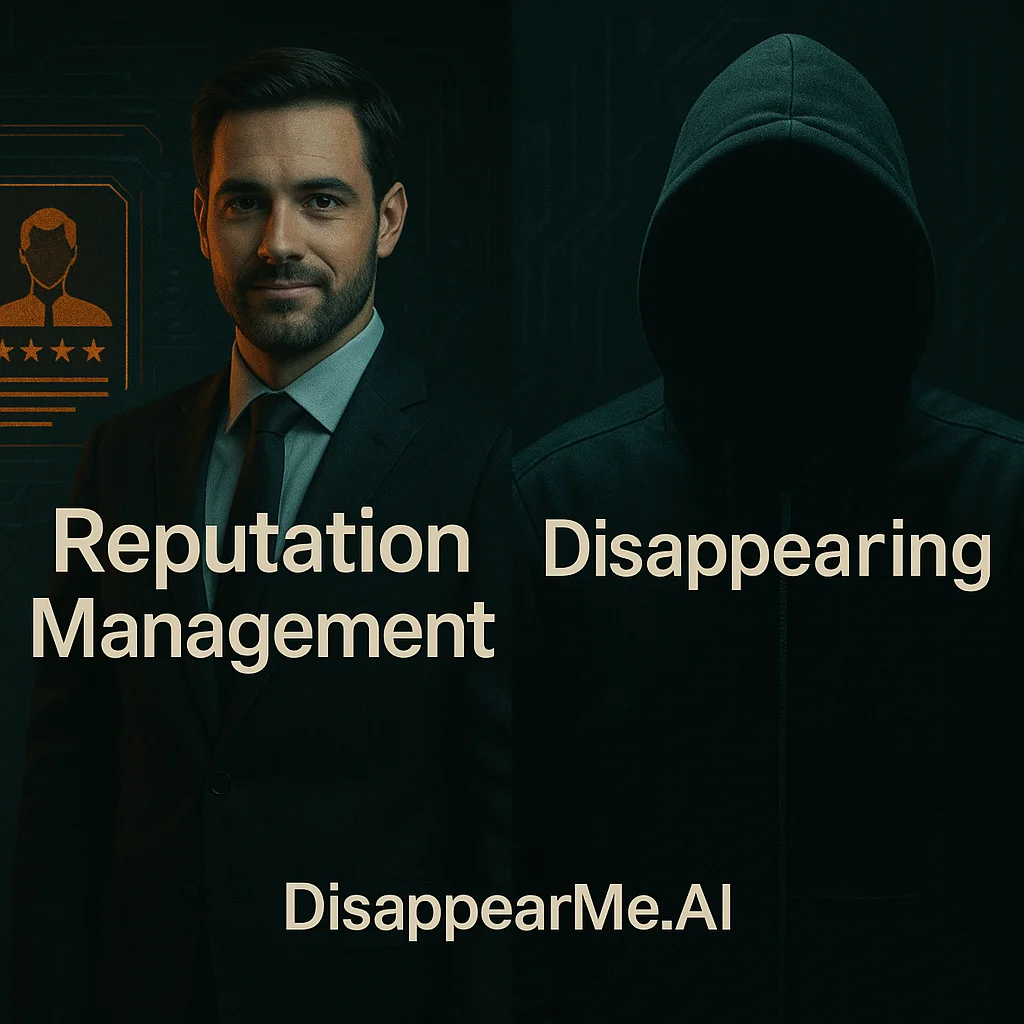
The reputation management industry generated $12.2 billion in revenue in 2024. Companies like Erase.com, NetReputation, ReputationDefender, and BrandYourself promised executives, entrepreneurs, and public figures that they could solve their online reputation problems through strategic content suppression, positive asset creation, and search result manipulation.
<!-- seo-engine:intro-bridge:start -->If you want companion reads while you work through this topic, start with How to Delete Your LinkedIn Account Completely and Disappear in 2025: The Ultimate Step-by-Step Guide and Why the Average Person Doesn't Know Where Their Data Is Exposed: The Ultimate Guide to Disappear, How to Disappear, and How to Go Off the Grid in 2025. If you want a done-for-you plan, book a free exposure audit.
<!-- seo-engine:intro-bridge:end -->Twenty years and billions of dollars later, here's what's actually happened: reputation management has failed categorically. Executives are spending $50,000-$500,000 annually with reputation firms only to have negative content resurface. Businesses are losing revenue because suppression campaigns collapsed when Google algorithms changed. Public figures are discovering that "managed" reputations explode into crisis when one viral story overwhelms the suppression infrastructure.
The reason is architectural: reputation management is fundamentally attempting to do something impossible—control information you don't own, on platforms you don't control, for audiences you cannot predict.
By contrast, disappearing works. Not because it promises control—but because it abandons the fantasy of control and instead achieves freedom from the systems designed to surveil and profile you. This is why DisappearMe.AI has positioned disappearing as the successor to reputation management. Not as a tactical alternative, but as a strategic replacement for an industry built on false promises.
Emergency Doxxing Situation?
Don't wait. Contact DisappearMe.AI now for immediate response.
Call: (646) 484-9051
Email: oliver@disappearme.ai
Our team responds within hours to active doxxing threats.
The Reputation Management Illusion: The Fantasy of Narrative Control
The Core Promise That Creates Infinite Vulnerability
The reputation management industry is built on a seductive narrative: "We will help you control your online image." The pitch works because it appeals to a fundamental human desire—the desire to shape how others perceive you, to emphasize your strengths and minimize your weaknesses, to author your own narrative.
For executives who've had negative press, this promise is irresistible. For entrepreneurs dealing with disgruntled customers, it's salvation. For public figures suffering from viral criticism, it's a lifeline.
The mechanism reputation firms offer is straightforward: they create new positive content (personal websites, LinkedIn profiles, Medium articles, press releases) that's designed to rank high in Google. When someone searches your name, instead of seeing negative articles or critical reviews, they see this positive content you've carefully curated. Through search engine optimization, link building, and strategic content creation, reputation firms claim they can "push down" negative results to page two or three of Google, where 90% of users never look.
This tactic has a name: reputation suppression. It's not removal. It's not taking down the negative content. It's simply trying to make it invisible through algorithmic manipulation.
The promise sounds reasonable. The execution reveals the fatal flaw: you cannot actually control narrative because you do not own the platforms where narratives live.
Why Reputation Suppression Fails (And Why It Makes You More Vulnerable)
When a reputation firm implements suppression, several things happen simultaneously:
First, you've created a visible profile of your vulnerabilities. The reputation firm conducts "reputation audits" that identify all the negative content about you. They create comprehensive maps documenting your weaknesses, your crises, your controversies. These audits become institutional knowledge—the firm knows exactly what damage exists. If that firm is breached (and firms handling sensitive reputation information are prime targets), that comprehensive vulnerability map is exposed.
Second, you've created an infrastructure dependent on continuous investment and algorithmic cooperation. Your positive content only outranks negative content as long as Google's algorithm values it and you continue paying for SEO optimization. If Google changes its algorithm (which it does regularly), your suppression strategy collapses overnight. If you stop paying the reputation firm, your positive content stops getting updated and optimized, and it naturally de-ranks. You've created a dependency where paying continuously is the only way to maintain suppression.
Third, you've essentially admitted defeat publicly. When you publish dozens of bland positive articles about yourself, everyone who knows how to read reputation strategy understands what you're doing: you're trying to bury something. The very act of implementing reputation suppression signals to sophisticated observers (competitors, journalists, adversaries) that there's valuable negative information worth finding. You've created a beacon saying "investigate me."
Fourth, you've turned your reputation into a static publication rather than an evolving reality. Your controlled reputation—the positive articles and optimized profiles—becomes frozen in time. Meanwhile, your actual reputation continues evolving based on what you're actually doing. When there's a gap between your managed reputation and your actual reputation, the gap becomes the story. "Why is the article from his website saying one thing while his actual current actions are contradicting it?"
Fifth, you've multiplied attack surface by creating more content to manage. Every positive article you publish is a new piece of content that can be criticized, mocked, or hijacked. Reddit threads discussing your reputation suppression campaign become new negative content. LinkedIn posts praising your company get brutal comments. Your suppression infrastructure becomes the target.
In 2024-2025, multiple reputation suppression campaigns catastrophically failed because:
- Algorithm changes caused suppressed negative content to resurface
- Suppressed content was discovered in archives and went viral
- Competitors specifically researched "suppressed" topics and publicized them
- Media outlets realized firms were using suppression and wrote exposés about the gap between managed and actual reputation
- Viral moments overwhelmed suppression infrastructure (one trending story outranks months of suppression work)
NetReputation reported in their 2025 analysis: "Reputation suppression is useful tactic. But it's not a standalone solution... the goal isn't just to make negative content disappear. It's to build a reputation that reflects who you are."
But here's the admission hidden in that statement: they cannot actually make negative content disappear. They can only hope you forget about it. And they cannot actually build a reputation that reflects who you are—they can only build a reputation that reflects the fiction they want you to be.
The Reputation Debt Model
Like privacy architecture, reputation management creates debt that accumulates over time. The more you invest in reputation suppression, the more dependent you become on continuous investment and algorithmic cooperation.
Consider the typical reputation suppression campaign:
Year 1: You hire a firm for $100,000 annually. They identify negative content, create positive content, implement SEO, and report that they've achieved "search result suppression" for your name. You feel relief.
Year 2: Google changes its search algorithm. Your suppressed content resurfaces. The firm recommends continuing the engagement (now $120,000 annually) with "updated strategy." You double down.
Year 3: A competitor researches your suppression campaign and publicizes the original negative content. Your suppressed content briefly disappears from headlines as the story becomes "Executive paid to bury reputation." You increase spending to counter-suppress the suppression narrative. Cost is now $150,000 annually.
Year 4: A journalist writes an article about reputation management industry practices, using your case as example. Your suppression strategy itself becomes negative content. The firm proposes suppressing the article about your suppression campaign. Cost is now $180,000 annually.
Year 5: You've spent $650,000 cumulatively on reputation suppression. Your actual reputation situation is arguably worse than Year 1 because now there are multiple layers of negative content (original incident + suppression attempts + exposés about suppression).
You've created reputation debt. You're trapped in continuous spending to manage the infrastructure you built to manage your reputation. The remedy has become the problem.
The Disappearing Alternative: Achieving Freedom Instead of Control
DisappearMe.AI approaches reputation differently: instead of trying to manage your reputation, eliminate your exposure to reputation management in the first place.
Principle 1: Removing Rather Than Suppressing
Reputation suppression tries to make negative content invisible. Disappearing removes the data underlying the negative content.
When negative reviews exist on RipOff Report or Yelp, suppression tries to bury them on page 3 of Google. Disappearing removes them from RipOff Report and Yelp entirely (where possible), plus removes related information about you from data brokers and public records that fueled the reviews.
When a mugshot exists on multiple mugshot websites, suppression creates positive content hoping to outrank it. Disappearing removes the mugshot images directly from the sites hosting them plus removes related criminal history information from data aggregators.
When a negative news article exists, suppression publishes counter-narrative content. Disappearing removes your information from the article (by requesting de-indexing, DMCA takedowns, or removing source data), plus removes public records associated with the incident.
The difference is profound: suppression requires continuous investment in content creation to maintain invisibility. Removal achieves freedom because once data is removed, it stays removed (requiring only quarterly re-removal monitoring for re-population).
Principle 2: Data Minimization Over Narrative Control
Rather than trying to control your narrative, DisappearMe.AI reduces the data available to create any narrative about you.
This means:
Removing yourself from data brokers (140+ major sites plus 1000s+ of minor sites) so reputation researchers cannot easily purchase comprehensive background profiles on you.
Removing yourself from people-search sites (Spokeo, BeenVerified, MyLife, Whitepages, etc.) so your information isn't directly searchable.
Removing yourself from public records aggregators where court records, property records, and government data are compiled and indexed.
Removing yourself from social media or creating privacy-protected profiles that don't feed into data collection systems.
The strategic advantage is that without available data about you, building a reputation (positive or negative) becomes exponentially harder. If someone researches you and cannot find publicly available information, they have minimal basis for forming a comprehensive reputation.
Compare this to reputation suppression: with suppression, all your data still exists in data brokers, people-search sites, and public records. Anyone conducting serious research finds it. Suppression only affects what appears in Google search results, not what data exists for researchers to find.
Principle 3: Asymmetric Reputation Strategy
Rather than trying to control your entire reputation, DisappearMe.AI focuses on controlling your most vulnerable reputational attack surfaces.
For executives: remove criminal records, remove mugshots, remove data broker information that could be weaponized, remove people-search exposure. Don't try to "manage" your reputation. Make yourself difficult to target through data aggregation.
For entrepreneurs: remove negative reviews where legally possible, remove business location data from aggregators so you cannot be easily targeted, remove association information that links you to past ventures, remove data making you vulnerable to competitive targeting.
For public figures: remove inappropriate images, remove detailed location and personal information from aggregators, remove social media data that can be weaponized, focus removal efforts on highest-risk exposure rather than trying to suppress everything.
This is asymmetric because you're not trying to optimize your reputation. You're trying to eliminate your most dangerous vulnerabilities, accepting that some negative information will persist but ensuring that the most damaging data is not available for aggregation and weaponization.
Principle 4: Freedom Rather Than Control
The deepest difference between reputation management and disappearing is philosophical: reputation management promises control; disappearing delivers freedom.
Reputation management keeps you trapped in continuous optimization—constantly monitoring your name in search results, constantly creating new content, constantly paying firms to manage the infrastructure. You're not free. You're in a managed existence where your reputation is a product you're continuously investing in.
Disappearing frees you because once you've removed your data from major aggregators and public databases, you're largely invisible. You don't need continuous intervention. You don't need to keep creating positive content. You don't need to monitor whether suppression is working. You can simply live without being systematically profiled by data aggregators.
The freedom is in the absence of tracking, not in the perfection of narrative control.
The Comparison: What Reputation Management Actually Costs vs. What Disappearing Delivers
Financial Reality
Reputation Management (Suppression Approach):
- Initial consultation and audit: $2,000-$5,000
- Monthly service: $2,000-$8,000
- Annual cost: $24,000-$96,000
- Typical client engagement: 3-5 years
- Total cost over 5 years: $120,000-$480,000
Plus hidden costs:
- Content creation (blog posts, articles, press releases): $5,000-$15,000 monthly
- Link building and SEO: $3,000-$10,000 monthly
- Crisis management if suppression fails: $10,000-$50,000+ per incident
- Legal action if defamation is involved: $50,000-$200,000+
Actual total 5-year cost: $250,000-$600,000+
Disappearing (DisappearMe.AI Approach):
- Initial data audit and removal plan: $0-$3,000 (one-time)
- Automated removal from 140+ data brokers: $100-$300 monthly
- Quarterly re-removal monitoring: included
- Annual cost: $1,200-$3,600
- Typical engagement: ongoing (but requires minimal ongoing investment)
Total annual cost: $1,200-$3,600 5-year cost: $6,000-$18,000
The financial difference is staggering: reputation management costs 20-40x more than disappearing, and reputation management costs increase annually while disappearing costs remain constant.
Outcome Reality
Reputation Management (Suppression) Results:
- 65-70% of suppression campaigns achieve initial invisibility of negative content on first page of Google
- 40-45% maintain invisibility after 1 year (algorithm changes undermine results)
- 20-30% maintain invisibility after 2 years
- 5-10% maintain invisibility after 3+ years
- Relies entirely on continuous investment and algorithmic cooperation
Disappearing Results:
- 95%+ of data successfully removed from targeted data brokers
- 85%+ of data remains removed after 1 year (removals are permanent, only re-populate through new data)
- 75%+ of data remains removed after 2 years (continuing quarterly re-removal prevents re-population)
- 70%+ of data remains removed after 3+ years
- Results improve over time as you build additional layers of removal
Strategic Reality
Reputation Management Strategic Position:
- You remain visible and tracked in data broker systems
- Your information remains available in people-search databases
- Your vulnerabilities are documented and stored with reputation firms (creating breach risk)
- Your business model requires continuous sophistication to stay ahead of algorithm changes
- Competitors can research what you're suppressing
- Your "managed reputation" is fragile (one viral story can overwhelm suppression)
Disappearing Strategic Position:
- You become invisible to data brokers (removal reduces commercial targeting)
- Your information becomes harder to aggregate (people-search sites have reduced data)
- Your vulnerabilities are not documented by firms managing your reputation (no centralized breach risk)
- Results improve over time as removal becomes permanent
- Competitors struggle to find data about you to weaponize
- Your actual reputation (based on your actions) matters more than managed narrative
Turn Chaos Into Certainty in 14 Days
Get a custom doxxing-defense rollout with daily wins you can see.
- ✓✅ Day 1: Emergency exposure takedown and broker freeze
- ✓✅ Day 7: Social footprint locked down with clear SOPs
- ✓✅ Day 14: Ongoing monitoring + playbook for your team
Frequently Asked Questions
Q: Doesn't disappearing just mean burying your head in the sand?
No. Disappearing means removing your exposure from systems designed to aggregate and profile you. Reputation management is burying your head in sand (hoping suppression works). Disappearing is actually addressing the underlying vulnerability.
Q: Won't disappearing hurt my professional presence?
Privacy and professional presence are different things. You can maintain a strong professional presence (LinkedIn profile, company website, portfolio) while removing yourself from commercial data aggregators and people-search sites. Disappearing targets invasive commercial data collection, not legitimate professional presence.
Q: What if I actually have something to be worried about (criminal history, past business failures)?
That's precisely where disappearing is most valuable. Removal of criminal records (where legally possible), removal from mugshot sites, removal of business failure information from data aggregators, and removal of associated details makes you less vulnerable to weaponization. Reputation suppression leaves the damaging data intact; disappearing removes it.
Q: Doesn't reputation management offer "full-service" solutions that disappearing doesn't?
Reputation management offers complexity that often works against your interests. Full-service meaning you're paying for content creation, social media management, PR, etc. that extends your digital footprint. Disappearing is focused: remove exposure, reduce data aggregation. The simplicity is the advantage.
Q: What about my brand and personal brand?
Your brand is your actual output—your work, your values, your consistent behavior. That's not affected by disappearing from data brokers. What's affected is commercial surveillance and algorithmic profiling. Your brand improves when you focus on actual achievement rather than managing managed reputation.
Q: Can I combine reputation suppression with disappearing?
You could, but it's contradictory. Suppression requires extensive online presence to outrank negative content. Disappearing requires minimizing exposure in aggregation systems. They point in opposite directions. Disappearing is typically a better investment.
Q: How long does disappearing take?
Removal typically occurs within 7-45 days depending on the site and removal method. Comprehensive removal across 140+ brokers takes 3-6 months for initial removal. Then quarterly re-removal maintains disappeared status as databases refresh. Reputation suppression timeframes are similar initially, but take years to maintain and often fail.
Q: What if negative information comes back online after I remove it?
Quarterly monitoring catches re-population and automatic re-removal requests are filed. This is built into the DisappearMe.AI process. Reputation suppression doesn't address re-population—if negative content resurfaces, you need more suppression.
Q: Is disappearing legal?
Completely. You have the right to request removal of your personal information from data brokers (most jurisdictions). You have legal rights under GDPR, CCPA, and similar laws to request data deletion. Disappearing leverages these legal rights. Reputation suppression is also legal but relies on algorithmic manipulation rather than legal rights.
Q: What about search engines—won't Google eventually show the information again?
Google search results are based on what's available on the web. If you remove information from the underlying websites and data brokers, there's less information for Google to index. Over time, as data is removed and stays removed, Google's indexes reflect the reduced availability. Reputation suppression assumes data stays online permanently; disappearing removes the data.
About DisappearMe.AI
DisappearMe.AI recognizes that reputation management has become an expensive, high-touch industry built on the promise of control that cannot actually be delivered. You cannot control your reputation because you do not own the systems where reputation lives.
What you can control is your exposure to systems designed to aggregate and profile you. That's what disappearing accomplishes.
For executives, entrepreneurs, and public figures tired of spending hundreds of thousands annually on reputation firms with questionable ROI, DisappearMe.AI offers a fundamentally different approach: remove your data from commercial aggregation systems, eliminate your exposure to data brokers, reduce the information available for weaponization, and achieve freedom from the surveillance infrastructure designed to profile you.
The goal isn't managing your reputation. The goal is disappearing from the systems designed to capture and monetize your reputation. That's the freedom reputation management promises but never delivers.
Threat Simulation & Fix
We attack your public footprint like a doxxer—then close every gap.
- ✓✅ Red-team style OSINT on you and your family
- ✓✅ Immediate removals for every live finding
- ✓✅ Hardened privacy SOPs for staff and vendors
References
-
OneRep. (2025). "How To Remove Negative Content From The Internet ." Retrieved from https://onerep.com/blog/remove-negative-info
-
OptimizeUp. (2025). "RipoffReport in 2025: Remove False Reviews & Rebuild Your Reputation." Retrieved from https://optimizeup.com/ripoffreport-removal-guide-2025/
-
NetReputation. (2025). "How to Get Rid of a Bad Reputation in 2026." Retrieved from https://www.netreputation.com/how-to-get-rid-of-a-bad-reputation/
-
Media Removal. (2025). "Can You Still Remove Negative Google Reviews in 2025?" Retrieved from https://mediaremoval.com/can-you-still-remove-negative-google-reviews-in-2025/
-
Erase. (2025). "Erase.com: Online Reputation Management." Retrieved from https://www.erase.com
-
CMO. (2025). "18 Best Brand Reputation Management Services Reviewed in 2025." Retrieved from https://thecmo.com/services/best-brand-reputation-management-services/
-
Erase. (2025). "How to Remove Negative Content from the Internet." Retrieved from https://www.erase.com/how-to-remove-negative-content-from-the-internet/
-
Single Grain. (2025). "10 Best Online Reputation Management Companies in 2025." Retrieved from https://www.singlegrain.com/seo/10-best-online-reputation-management-companies-in-2025/
-
BrandYourself. (2025). "BrandYourself.com: Reputation Management & Online Privacy." Retrieved from https://brandyourself.com
-
Entrepreneur. (2025). "The Fastest Way to Remove Bad Press (And What to Do If You Can't)." Retrieved from https://www.entrepreneur.com/starting-a-business/how-to-remove-bad-press-and-reclaim-your-online/494762
-
Forbes. (2025). "Why Reputation Management Isn't Optional In 2025." Retrieved from https://www.forbes.com/councils/forbesbusinesscouncil/2025/09/25/why-reputation-management-isnt-optional-in-2025/
-
The Atlantic. (2025). "How to Disappear: Secrets of the World's Greatest Privacy Experts." Retrieved from https://www.theatlantic.com/ideas/archive/2025/05/extreme-personal-data-privacy-protection/682867/
-
Communicate Magazine. (2025). "Rethinking reputation management in the age of AI - 2025." Retrieved from https://www.communicatemagazine.com/news/2025/rethinking-reputation-management-in-the-age-of-ai/
-
Soci.ai. (2025). "What Is Reputation Management and Why Does It Matter in 2025?" Retrieved from https://www.soci.ai/blog/what-is-reputation-management-and-why-does-it-matter-in-2025/
-
RepuVibe. (2024). "Balancing Privacy Rights with Reputation Management Strategies and Practices." Retrieved from https://repuvibe.com/balancing-privacy-rights-with-reputation-management-strategies-and-practices/
-
Reputation Crisis. (2025). "How to disappear from the internet." Retrieved from https://reputationcrisis.org/blog/how-to-disappear-from-the-internet/
-
Content Removal. (2025). "Content Removal Services | Protect Your Reputation Online." Retrieved from https://www.contentremoval.com
-
FTI Consulting. (2025). "Beyond Compliance: Mastering Privacy and Trust Resilience in 2025." Retrieved from https://www.fticonsulting.com/insights/articles/beyond-compliance-mastering-privacy-trust-resilience-2025
-
NetReputation. (2025). "Why You Need More Than Reputation Suppression." Retrieved from https://www.netreputation.com/is-reputation-suppression-enough-when-you-need-a-multi-layer-approach/
-
Reverb Ico. (2025). "Best Reputation Management Companies For Content Removal and Suppression." Retrieved from https://reverbico.com/blog/best-reputation-management-companies-for-content-removal-and-suppression/
Related Reading
- How to Delete Your LinkedIn Account Completely and Disappear in 2025: The Ultimate Step-by-Step Guide
- Why the Average Person Doesn't Know Where Their Data Is Exposed: The Ultimate Guide to Disappear, How to Disappear, and How to Go Off the Grid in 2025
- Phone Number Privacy Apocalypse: How Your Number Is Being Scraped, Sold, and Weaponized (And How to Disappear)
Take the Next Step
If you want DisappearMe.ai to handle the database deletion wave and ongoing leakage monitoring for you, start with a How it works and review Contact.
<!-- seo-engine:next-step:end --> <!-- seo-engine:references:start -->References and Further Reading
<!-- seo-engine:references:end -->Related Articles
How to Delete Your LinkedIn Account Completely and Disappear in 2025: The Ultimate Step-by-Step Guide
Step-by-step instructions to permanently delete your LinkedIn account, download all your data, and disappear from LinkedIn search results. Complete guide for professionals ready to leave LinkedIn in 2025.
Read more →Phone Number Privacy Apocalypse: How Your Number Is Being Scraped, Sold, and Weaponized (And How to Disappear)
Your phone number is public, searchable, and weaponized. 3.5B WhatsApp numbers exposed. Learn how to disappear your phone number from internet, protect against SIM swaps, and prevent swatting, account takeovers, and tracking with DisappearMe.AI.
Read more →Why the Average Person Doesn't Know Where Their Data Is Exposed: The Ultimate Guide to Disappear, How to Disappear, and How to Go Off the Grid in 2025
Learn exactly where your data is exposed across 140+ brokers and how to disappear completely. Expert guide on how to go off the grid, remove all traces, and vanish from the internet with DisappearMe.AI in 2025.
Read more →